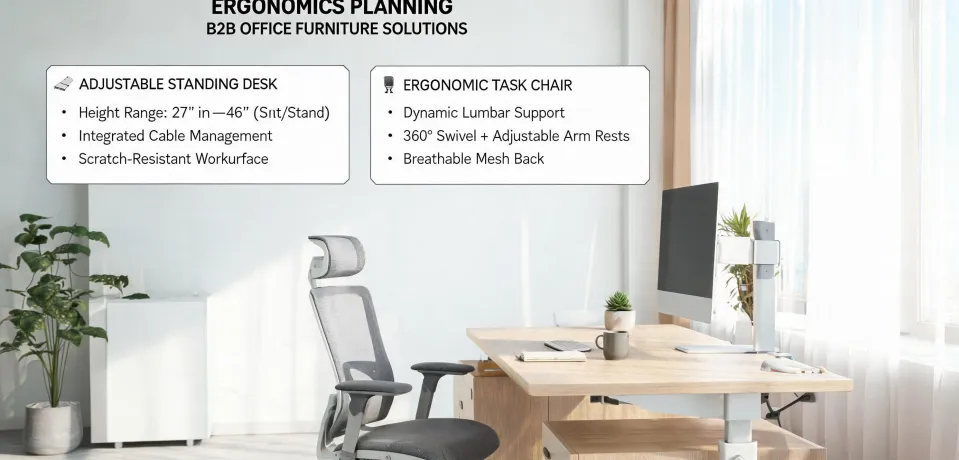
It started in early January, when our COO walked into my office with that look. You know the one – it means a project with a tight deadline and a tighter budget. We'd just signed a contract to add 25 people to our healthcare billing operations team, and they needed desks, chairs, and full setup before the end of Q1. My job: make it happen without blowing the annual procurement budget I've been protecting for six years.
Over that time, I've managed close to $180,000 in cumulative office spending. I've negotiated with more vendors than I can count and documented every order in our cost tracking system. But this one felt different. It wasn't just about buying furniture – it was about outfitting a team that processes prior authorizations and medical coding. These people sit (or stand) at their computers for 8 to 10 hours a day. Get this wrong, and we'd pay for it in productivity and comfort complaints.
I Got Burned Once. I Don't Buy the Cheapest Anymore.
The thing is, I didn't always think this way. When we furnished our old office in 2020, I made a classic procurement mistake. The budget-friendly ergonomic chairs were $120 each, and I figured I was being smart. Fast forward 14 months, and we were replacing six of them. The gas lift cylinders failed on four. One armrest snapped clean off. Net loss: roughly $1,600, including the hours we spent dealing with returns. The "cheap" choice ended up costing way more than the decent option would have. That's when I built my first total cost of ownership spreadsheet, and I've used one for every meaningful purchase since.
If I remember correctly, my rule now is simple: nothing above $300 gets approved without a TCO calculation. Not just sticker price, but shipping, warranty, maintenance, and the cost of downtime if the thing fails. Sounds obvious, but you'd be surprised how many buying decisions end at "which one is cheaper."
The Research Phase: Uplift Kept Showing Up
For standing desks, one name kept surfacing in our research: Uplift Desk. The V2 frame, the L-shaped V2, and the new V3 curved corner were the models we looked at hardest. Reviews were strong, the company had a long track record, and the customization options – top sizes, laminate colors, T-leg vs C-leg frames – stood out. Per FTC advertising guidelines, though, we couldn't just take vendor claims about ergonomic benefits at face value; claims have to be truthful and substantiated. So we leaned on independent reviews and peer-reviewed sit-stand research rather than marketing pages. As a cost controller, the customization options got my attention, but I still went straight to the pricing.
I built a comparison across three vendors. One competitor's base price ran about $120 cheaper per desk. But when I calculated the total package – shipping, warranty add-ons, and the assembly service we'd need – the savings evaporated. That competitor also didn't include a programmable controller on its base model; that was an extra $75 per desk. Uplift's V2 includes the advanced controller with four memory height settings as standard. When I ran the numbers across a 5-year lifespan, Uplift actually came out about $85 per desk less than the "cheaper" vendor.
The upside of going with the cheaper vendor was about $3,000 in upfront savings. The risk was a warranty that didn't cover electronics, slower support, and a higher chance of part failures. I kept asking myself whether that $3,000 was worth the potential downtime across 25 workstations. It wasn't.
The Cross Product Calculator (That's What My Team Calls It)
My team jokes that I run a cross product calculator when I compare vendors. It's not a math tool – the nickname started because our spreadsheet crosses out products and multiplies all the hidden variables. We essentially build a relative value metric for each option: cost per year, cost per feature, cost per square foot of workspace. One of the billing leads said we'd built an "RVU calculator for furniture." For those who don't work in healthcare, RVU stands for relative value unit – it's how medical providers measure productivity and cost across different procedures. The joke stuck, and honestly, it's not a bad metaphor. TCO for a desk is a lot like an RVU calculation: you're weighting multiple factors that don't show up on the invoice.
After comparing nine desk configurations across the three vendors, we went with Uplift. The decision wasn't about the brand name. It was about total cost, the 15-year frame warranty, and the fact that replacement parts were actually available.
Ordering and the Login Portal
I created an account on upliftdesk.com and used the login portal to manage the whole order. We ordered 25 desks – a mix of V2 and L-shaped frames – plus 25 J3 ergonomic chairs. The J3 struck the sweet spot between adjustability and price. We'd also looked at the Facet and Pursuit models, but the J3's adjustable lumbar, seat depth, and armrests were enough for what our team needed.
The configurator was surprisingly deep. We needed grommet holes in some tops, a specific laminate finish to match our office branding, and a mix of T-leg and C-leg frames. All of that was handled online, and I could log in anytime to check order status and invoices. That level of transparency is way more than I expected from a large furniture order.
Actually, we almost lost the timeline. I wanted two more weeks of comparison, but the COO needed the order placed before February if we wanted delivery before the team started. I made the call with the data I had – the TCO spreadsheet plus the warranty terms – instead of waiting for perfect information.
The ASR Error That Almost Derailed My Week
Delivery went smoothly. Freight arrived on time, packaging was solid, and our facilities team had everything assembled within two days. Then came the hiccup. One V2 desk threw an error on its control panel. The display showed an ASR error, which we later learned is related to the desk's anti-collision and speed regulation system. It would lower fine but wouldn't go up past a certain height.
My first thought: here we go, a support nightmare that eats my week. I was wrong. I logged into our Uplift account, opened a support ticket, and within a few hours they identified it as a calibration issue. The fix was a reset sequence – you hold the down button until it shows "ASR," then tap up a few times. (I might be getting the exact sequence wrong, but it was something close to that.) The desk worked perfectly afterward. Total time lost: maybe 30 minutes. Compare that to the chair fiasco in 2020, where support took three weeks to reply – and then told us to buy new chairs.
How to Choose an Office Chair for a Whole Team
The chairs were honestly the harder decision. Desks are simple once you settle on size, frame, and height range. Chairs are personal – a 5'2" billing specialist and a 6'4" team lead need different things. Here's what I'd tell anyone facing the same question:
- Seat depth adjustability is non-negotiable. If the seat pan doesn't slide, someone's thighs will hurt after a week.
- Lumbar support has to move. A fixed bump does nothing for half your workforce.
- Check the weight capacity. Match it to your actual team, not the marketing average.
- Ask about replacement parts. Can you get a new cylinder in three years, or do you have to replace the whole chair?
The J3 checked all of those boxes. It wasn't the cheapest chair we looked at, but it had the features our team actually needed without forcing everyone into a top-end model.
The Result and the Lessons
By the end of Q1, all 25 workstations were live. The team moved in, and I braced for complaints. There were almost none. A couple of people asked for monitor arm adjustments, and a few wanted anti-fatigue standing desk mats, so we ordered those too. (I should add: Uplift sells those as well, and the mats from our old vendor had a smell that never went away – these don't.)
Dodged a bullet on the accessories budget, honestly. If I hadn't set aside $200 for small items, I'd have been stuck in the approval cycle over a $40 mat. Small line items still count.
What Changed for the Team
Over the following months, the team's feedback was noticeably more positive than the team in our old office. Monthly check-ins showed fewer complaints about back and neck discomfort. We can't scientifically isolate the cause – it's an office, not a lab – but I'm glad we didn't cheap out.
Some best practices from 2020 are genuinely outdated. Back then, you'd buy whatever your local office supply store had on sale, and a decent standing desk cost a fortune. Now, direct-to-consumer brands like Uplift offer better build quality, better warranties, and better customization at a price that beats the old middlemen. But the fundamentals haven't changed: total cost still beats sticker price, and vendor support matters more than you realize until something breaks.
If I had to sum up the whole project in one line: the best decision I made wasn't picking Uplift. It was stopping long enough to calculate the real cost of everything – and having a process that forced me to. The procurement policy I created after the 2020 fiasco now requires a TCO comparison for any purchase above $300, quotes from at least three vendors, and a review of warranty terms. It took getting burned to build that process, but it's saved us way more than it cost.
Oh, and one more thing. When you're comparing standing desks, don't overlook the login and support experience. Being able to check order status, reprint invoices, and open a support ticket without calling anyone turned out to be one of the things I appreciated most. It won't show up on a spec sheet, but it's part of the total cost of ownership – just like everything else.

Discuss this article with a workspace planner