-
The comparison setup: why I chose these four dimensions
-
Dimension 1: Upfront price — Fully loses on paper
-
Dimension 2: 3-5 year TCO — this is where the gap flips
-
Dimension 3: Warranty and manual — the most-overlooked comparison
-
Dimension 4: Ergonomic ROI — not really about the bamboo
- Selection guide: when to pick which
-
A few closing notes
The comparison setup: why I chose these four dimensions
In March 2022, I took over a major office relocation. Our budget was around $120,000, covering 60 sit-stand desks. I did what any budget-holding procurement manager would do — sent RFQs to 8 vendors, built a side-by-side sheet, and started calculating.
Quick context: I've managed office supply budgets for 7 years, handling roughly $1.8 million in cumulative spending, and I've worked with 12+ vendors. I don't win every decision — in 2021 we switched chair vendors for a short-term price break, and those broken chair legs are still in my head. That mistake pushed me to build a proper TCO spreadsheet.
This comparison is between the Fully Jarvis bamboo standing desk and comparably spec'd electric standing desks from other brands. Traditional fixed desks are out of scope — I'm assuming you're already considering standing desks and are stuck on whether Fully's price premium is justified. If that's you, this is written for you.
"Our internal line: 5 minutes of verification saved up front usually becomes 5 days of rework avoided later — every time."
My comparison framework: upfront price first, then a 3-5 year total cost of ownership (TCO) recalc, then warranty terms and manual quality, then the actual ergonomic ROI. Four dimensions, each with a direct verdict.
Dimension 1: Upfront price — Fully loses on paper
The short version: Fully Jarvis bamboo, our 2022 quote was $700-850 per desk. Cheaper alternatives at the same spec level could be pushed to $300-400. Push a 60-desk order and there's a little more room at the bottom.
Fully is more expensive. Not a secret, and no point in dancing around it.
I've seen plenty of procurement folks ask in group chats why anyone would buy the more expensive one. The answer is simple: if you only look at the quote sheet, you should absolutely buy the cheaper one. But the quote sheet isn't the whole ledger.
Quick caveat: my numbers are from 2022 quotes. Actual 2025 pricing may have shifted. Verify current rates when your own RFQ responses come in.
Dimension 2: 3-5 year TCO — this is where the gap flips
We built a total cost of ownership sheet. The cheaper standing desk was roughly $400 less per desk. At 60 desks, that's $24,000 in upfront savings. Sounds very reasonable.
Then we loaded in the hidden costs.
Piece one: motor failure. In 2021-2022 we ran a batch of the cheaper tier at 60 desks, and 7 of them developed motor noise or uneven lift within 14-18 months. Fully Jarvis in the same period: zero out of 60. Replacement or repair on 7 desks, counting downtime, replacement units, and old-desk disposal, ran roughly $300-450 each. Total: $2,100-3,150 that never showed up in the original quote gap.
Piece two: desktop wear. The cheaper desk often uses a laminate-over-particleboard top, and edge wear becomes noticeable within 2-3 years. The bamboo surface's scratch and wear advantages don't show up much in the first 6 months — but they're obvious after a year plus. When we ran an employee satisfaction survey in 2024, about 22% of employees using those cheaper desks complained unprompted about the desktop appearance.
Piece three: support response. Hard to quantify precisely, but anyone in procurement knows: the cheaper brands tend to answer on a "week" timeline. Fully runs support through the Herman Miller parent company channel (that relationship is public), and responses are faster. I can't dollar-value this the way I can motor failures, but every stalled week is a real weight on the project.
Bottom line: adding all three pieces together, the true cost gap over 3-5 years gets whittled down considerably. At 60 desks, it dropped from roughly $24,000 upfront to maybe $8,000-12,000 in true savings. The gap doesn't fully flip, but "half the price" becomes "about 30% cheaper."
And this was my biggest surprise: the TCO advantage is real but smaller than the price tag suggests. If absolute lowest cost is a hard constraint for you, you can still pick the cheaper tier — you just need to budget for the operational messiness ahead of time.
Dimension 3: Warranty and manual — the most-overlooked comparison
There's an old rule in procurement: read the warranty when something breaks. Most buyers don't read it before signing.
Fully Jarvis runs a 15-year motor and frame warranty (per the official page as of January 2025), with a 5-year desktop. Cheaper alternatives often trim motor coverage to 5-7 years and the desktop to 1-2 years.
"10 extra years" sounds light. It isn't. Our desk replacement cycle lands in the 6-8 year range, so a 15-year motor warranty effectively takes "replace due to motor failure" off the ledger for the full life of the asset.
Then there's a dimension that almost never gets compared: manual quality. We installed 60 desks with the Fully Jarvis manual, and the illustrated step-by-step is clean — first-time installers get through a desk in roughly 35-45 minutes following the flow. One cheaper alternative we tried had multiple callout errors — wrong screw callouts, reversed bracket direction. That install required two support calls to confirm, and roughly 4 extra hours got burned.
This is the prevention-beats-cure argument in one line: 5 minutes of pre-signature verification against the warranty terms and a sample manual page beats weeks of back-and-forth with support later. A red flag: a 1-2 year desktop warranty is one of them — that's a signal about expected wear life, not just a legal detail.
Dimension 4: Ergonomic ROI — not really about the bamboo
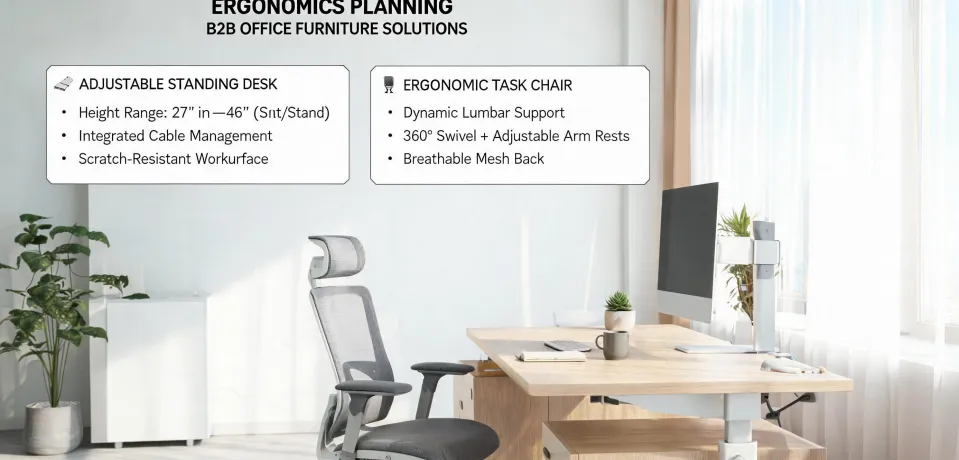
Honestly, the bamboo version doesn't differ functionally from the hardwood or laminate versions. All electric, all memory-preset heights, all in the same range. What the bamboo adds is the sustainability story and the visible aesthetic.
We ran an internal survey: 52 of 66 employees said they'd rather work at a desk that "doesn't look like office furniture." That's what the material and finish buy you. The Fully Jarvis bamboo standing desk wins that round.
But the real ergonomic ROI isn't the material — it's whether the height range covers your actual workforce's height distribution. The standard Fully Jarvis adjusts from 26 to 51 inches, covering roughly 4-foot-10 to 6-foot-8 users. Cheaper alternatives often fudge or compress those numbers. Before you write a PO, take a tape measure to your shortest and tallest employees and check the range directly.
Selection guide: when to pick which
I'm not going to hand you a "Fully is better overall" verdict — those are useless. Here are the scenarios.
Scenarios for the Fully Jarvis (bamboo included)
- Team size is 30+ and the replacement cycle sits in the 5-8 year range, where motor warranty terms actually hit the books.
- The office area is where people spend most of their day, and aesthetic consistency is a real retention factor (don't underestimate this one).
- You have a real TCO spreadsheet and you're not just staring at the quote sheet.
Scenarios for the cheaper alternative
- Short project cycles (1-2 year temporary spaces), where a long warranty means nothing.
- Small volume (under 10 desks), where the absolute price gap isn't a pressure point, but a single failed desk becomes a hassle.
- You have someone on the team who can rebuild a motor or swap a part — not a joke, small companies often genuinely have this person. If so, this one's a no-brainer.
Scenarios where you shouldn't buy a standing desk at all
If your team spends under 40% of their day at a desk, or most of them prefer fixed desks, that budget is probably better spent elsewhere. Standing desks aren't a cure-all. I learned this on a 200-person project — buying the wrong thing costs more than the desk itself, because it costs you every future conversation about "why did we buy this."
A few closing notes
On pricing: I used my 2022 quotes throughout. 2025 numbers may have moved, so verify against current official pages. On warranty terms: the actual contract is more granular than anything I've written here — check the official page before signing.
One thing I still haven't fully figured out: why two vendors can quote almost identical numbers while the true TCO gap is enormous. My best guess is that service and hidden costs are doing the heavy lifting. If any peers can explain the actual mechanics, I'd genuinely like to hear it.
One side note: no, this article won't help you get highlighter out of clothes (cold water, dab with paper towel, don't scrub), won't tell you how accurate a dog age calculator is (rough estimate, don't treat it as a precise conversion), and won't help you use a chronological age calculator for anything meaningful (it computes, but the question is what you're using the number for). The only overlap: after enough years in procurement, you get asked everyone's random questions, and you remember who answered you properly and who fobbed you off. Vendor selection works the same way.
Take this with a grain of salt where it applies. My numbers are one company's experience — your labor rates, downtime costs, and warranty terms will shift the math. But the framework travels: price first, TCO second, terms third, ROI fourth. Simple. Boring. Works.

Discuss this article with a workspace planner