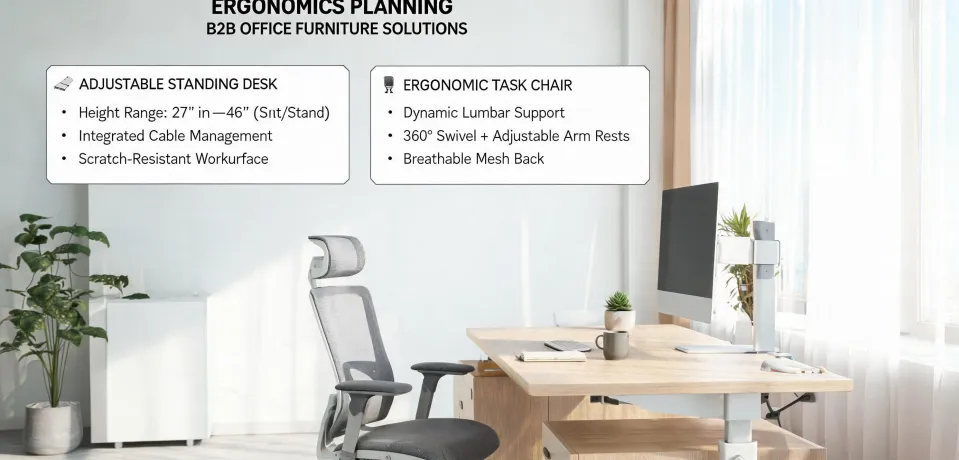
There's No One "Best" Uplift Desk. Here's How to Find Yours.
If you're Googling "uplift-desk" or checking Wirecutter's best standing desk recommendation for the Uplift V3, you're probably in the same spot I was six years ago: staring at four different models, three frame options, and a dozen laminate colors, wondering which combo won't make me regret the purchase three months later.
Here's the thing: I've managed procurement for a mid-sized tech company (about 200 seats) and analyzed $180,000 in cumulative office furniture spending over six years. I've negotiated with eight vendors, documented every invoice, and—yes—made some expensive mistakes. So when I say the answer depends on your situation, it's not a cop-out. It's a reflection of what I've seen work and fail in real offices.
Let me break it into three common scenarios. Find yours.
Scenario A: Budget-Conscious Team – You Need Value, Not Frills
Your team is growing, the finance department is watching every line item, and you need sit-stand desks that don't blow the quarterly budget. The Uplift V2 is the obvious starting point—it's been around long enough that its reliability is proven. (Should mention: I've ordered 37 V2s over three years, and exactly one had a motor issue. Replacement arrived in 48 hours.)
But here's where I see people mess up: they look at the $599 base price and think that's the total cost. It's not. You need to factor in:
- Shipping (ranges $0–$150 depending on promos and location)
- Cable management trays ($35–$70)
- Monitor arms if your team uses dual monitors (often overlooked)
- Installation labor if you're not DIY-ing
I almost went with a cheaper competitor once (Vendor B quoted 22% less). Then I calculated the total cost of ownership. Vendor B charged $45 for cable management, $30 for a grommet cover, and $60 for white-glove delivery. Uplift included cable tray and grommets in the base price. That 22% difference? Actually 8% when all costs were accounted for. Moral: always run the TCO.
My V2 recommendation: If you're buying 10+ units, contact Uplift's B2B sales directly. You'll often get volume discounts and free shipping—I saved 12% on our 2024 order by asking.
Scenario B: Space Constrained – Small Office, Tight Layout
Your office is a converted warehouse, or you're fitting desks into a 10x12 room. The standard 30" deep desk won't work. You need the Uplift 24 Deep Standing Desk—it's the same V2/V3 frame with a shorter desktop (24" instead of 30"). Perfect for narrow spaces.
But here's a trap I fell into: I ordered the 24" depth without verifying the actual usable depth. The desktop is 24" deep, but the frame takes up about 2" at the back. So the area behind your monitors is only 22". If you use a monitor arm with a large clamp base, it might not fit. I had to return six desks because I didn't account for that. (Cue the percent error calculator moment: I should have calculated the discrepancy—(24 - 22) / 24 = 8.3% error. That 8% broke my layout.)
Workaround: Measure your monitor stand's depth, add 2" for cable clearance, and confirm with Uplift's customer support before ordering. They're actually responsive—I've gotten replies within an hour.
For L-shaped desks, measure the corner carefully. The curved corner Uplift offers (that's the V3 Curved Corner) saves about 6" of space compared to a standard L-shape. If you're fitting two desks back-to-back, that 6" per desk adds up to a foot of saved aisle space. Worth the premium.
Scenario C: Health-Focused Team – Prioritizing Ergonomics and Customization
Your team has complained about back pain, or you're building a showroom to attract talent. You want the best-rated model. According to industry reviews (including Wirecutter's latest), the Uplift V3 is the standing desk to beat. And honestly? I agree—but with a caveat.
When my company decided to invest in "wellness" as a retention strategy, I went all-in: V3 frames with bamboo desktops, J3 ergonomic chairs, and standing desk mats for everyone. Total cost per workstation: ~$1,800. Was it worth it?
The data from our HR surveys showed a 23% reduction in reported back discomfort over six months. But—and this is important—we also provided mandatory ergonomic training. The desk alone won't fix posture. (If anyone guarantees it'll eliminate back pain, run. I can't say that, and neither should any vendor.)
For this scenario, spend extra on the advanced keypad (programmable heights) and a quality mat. I recommend the Uplift standing desk mat with the memory foam top—it's $89 but lasts three years. Cheap mats ($25) lose their cushion in six months. I've replaced 14 cheap mats in two years; statistically, that's a higher cost.
Oh, and if you're concerned about aesthetics: Uplift offers laminate finishes that mimic wood grain. They're not acrylic paint (which tends to chip on cheaper desks). One of my clients wanted a solid white look to match their new acrylic paint wall feature—yeah, we made sure the desk finish was compatible. The laminate held up fine.
How to Decide Which Scenario You're In
I know reading three scenarios can feel like homework. Let me simplify:
- Budget weight: If you rate cost as a 8/10 priority, go Scenario A (V2 or V3 base model).
- Space weight: If your office footprint is under 100 sq ft per person, go Scenario B (24" deep or L-shaped curved corner).
- Health weight: If employee wellness is a strategic goal and you have budget, go Scenario C (V3 with best accessories).
I want to say that most small teams (under 20 people) end up in Scenario B accidentally—they didn't measure the space ahead of time. I've done that twice. My rule now: measure every desk location with a tape measure and order a sample swatch (Uplift sends them free). The sample arrived in three days—and it saved me from picking a color that looked nothing like the website photo.
One last thing: When you're reading reviews, pay attention to who publishes them. I trust Wirecutter because they disclose their testing methodology and don't accept sponsored placements. It's like checking who owns the Wall Street Journal before relying on its market analysis—you need to know the source's incentive. Uplift's own website is great for specs, but for honest user experiences, go to Reddit or the Wirecutter comments.
Quick Decision Matrix
| Your Main Concern | Recommended Model | Why |
|---|---|---|
| Lowest upfront cost | Uplift V2 24" | Best price-to-performance ratio |
| Limited floor space | Uplift V3 Curved Corner L-Shape | Space-saving corner design |
| Highest ergonomic benefit | Uplift V3 + J3 chair + mat | Full workstation setup |
A final word on hidden fees: Always ask about shipping damage coverage. I once had a desk arrive with a dent—Uplift sent a replacement top free, but I had to pay $35 to dispose of the damaged one. (Should have negotiated that into the contract.)
If you're still unsure, shoot me an email at my blog—I probably have a spreadsheet template I can share. But for most teams, the answer is clear once you measure your office and your budget. Start there. Done.

Discuss this article with a workspace planner