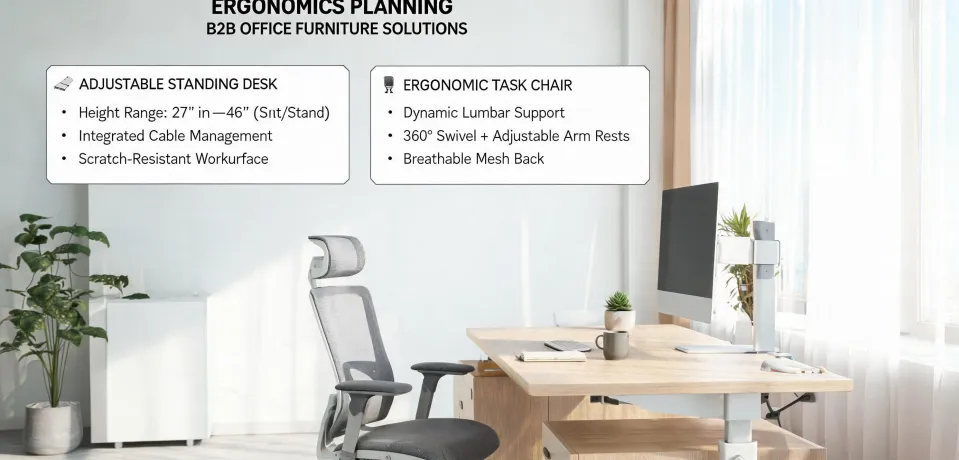
I Almost Approved a Purchase That Would Have Haunted Me
Last quarter, I was ready to pull the trigger on 20 standing desks for our new office layout. The budget was approved, the timeline was tight, and the pressure was on. I'd done my homework—or so I thought.
The vendor I was leaning toward offered a price that was roughly 30% lower than UPLIFT Desk's equivalent model. From the outside, it looked like a no-brainer. Lower price, similar features, faster delivery. What's the catch?
Let me rephrase that: I thought the features were similar. I hadn't looked closely enough at the specs. And that almost cost us—not just money, but credibility with my VP and months of headaches for our team.
What I Thought I Was Comparing
At first glance, both desks offered sit-stand functionality, similar height ranges, and programmable memory presets. The price difference seemed like a simple premium for the UPLIFT brand. I told my operations director, 'We can save $16,000 and get basically the same thing.'
Put another way: I was comparing the menu descriptions, not the nutritional information. The real differences were hidden in the fine print.
The 3 Things I Missed (And Why They Matter)
1. Motor Duty Cycle: The Hidden Limitation
This was the biggest surprise. The cheaper desk had a motor rated for 2 minutes of continuous use, followed by 18 minutes of cooling. That's fine for occasional adjustments. But in a hot-desking environment with 20 people cycling through, some desks would be adjusted 10+ times a day.
Our team at the time was processing roughly 60-80 procurement requests annually across 8 vendors for different needs. I knew from experience that a small spec like this would become a major issue when people started complaining that their desks 'stopped working' mid-adjustment.
(Should mention: the UPLIFT V2 and V3 desks use motors with a duty cycle rated for heavy commercial use—something I only discovered after talking to their sales rep.)
2. Stability at Standing Height: The Wiggle Test
People assume that all standing desks are equally stable. The reality is that stability depends heavily on the frame design and cross-support structure. The cheaper desk had a single-column frame with minimal bracing. When I tested a floor model—oh, and I should add they didn't have a local showroom, so I had to track one down—the monitor wobbled noticeably at standing height.
For a team of designers who spend hours on dual monitors, that wobble would have been a daily frustration. UPLIFT's V3 curved corner desk, in contrast, uses a T-frame with additional crossbars. It's a detail you don't think about until you're trying to do precision work on a screen that's shaking.
From the outside, it looks like 'all standing desks work the same.' The reality is the engineering underneath makes or breaks the user experience.
3. The Frame's Impact on Ergonomics
The cheaper desk had a fixed height range from 29 to 48 inches. That seemed fine until I realized one of our developers is 6'5" with a standing elbow height of 48 inches—right at the desk's maximum. He'd have to use it at the very top setting with no room for keyboards or monitor arms.
The UPLIFT V2 offers extended range options (22.6 to 48.7 inches in some configurations), and the V3's curved corner model provides more flexible placement. It's not just about hitting the right number; it's about having room to work at that height.
The Real Cost of the 'Cheaper' Option
Let's say I'd ordered those 20 cheaper desks. Here's what that would have looked like after 6 months:
- Motor repairs on 4 desks (due to duty cycle limits): roughly $200 per repair, if covered under warranty—if not, double that. That's $800–$1,600 potentially out of my department's budget.
- Two team members requesting replacement desks due to stability issues: at $600 per replacement desk, that's $1,200.
- Lost productivity from frustrated employees: hard to quantify, but my VP would definitely be hearing about it.
In our 2024 vendor consolidation project, I learned that saving 5 minutes of verification upfront often prevents 5 days of correction later. This was a textbook case. The 5 extra hours I spent comparing specs has probably saved us from a mess that would have taken weeks to sort out.
What I Actually Ordered (And Why)
I ended up going with a mixed deployment: 12 UPLIFT V2 standing desks for standard workstations, 4 V3 curved corner desks for collaborative spaces, and a few of their J3 ergonomic chairs for the team members who had specific back issues (per their ergonomic assessment—I always route those through HR first).
The total cost was higher than the 'budget option,' but the total cost of ownership—factoring in durability, warranty terms, and user satisfaction—made UPLIFT the clear winner.
My experience is based on managing about 200 procurement orders for office furniture across multiple companies. If you're working with a much smaller team or a very short-term project, your needs might differ. But for any organization that values longevity and user comfort, I'd argue the specs are everything.
The American Society for Testing and Materials (ASTM) has a standard (ASTM F3096-14) for evaluating stability and durability of height-adjustable desks. That's the kind of spec you want to reference, not just a price tag. As of July 2025, verified compliance with that standard is a solid baseline for any serious purchase.
The Bottom Line
I still second-guessed my decision after hitting 'approve.' What if the budget team pushed back? What if the delivery was delayed? The two weeks until installation were stressful. But once the desks were in place and the team started using them, I knew I'd made the right call.
Don't buy a standing desk based on price alone. Dig into the spec sheet. Check the motor duty cycle. Look at the frame stability. Consider the height range for your tallest team member. That 20 minutes of research could save you thousands in hidden costs and—more importantly—keep your team happy and productive.

Discuss this article with a workspace planner