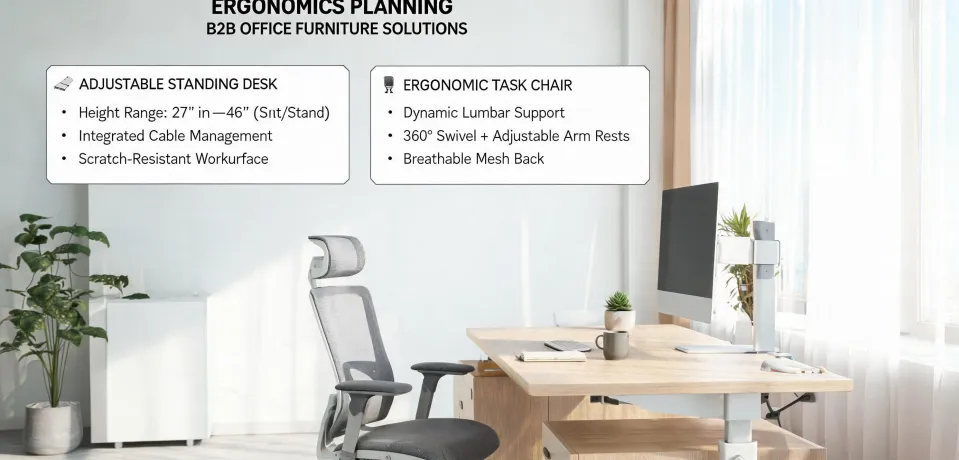
If you're like me, the first thing you do when you see the Uplift desk website is get overwhelmed by the options. Desks, frames, sizes, finishes—and then the accessories. Mats, monitor arms, cable trays, keyboard trays, file cabinets, power grommets. It's a lot.
I've been managing office procurement for a mid-sized tech company for about 5 years now—roughly $300K annually across 8 different vendors. When we decided to switch everyone to standing desks in 2023 (partly for ergonomics, partly because the CEO read a Harvard Business Review article), I was the one tasked with figuring out what we actually needed.
Here's the thing: there's no one-size-fits-all answer. Your accessory needs depend on your office setup, your team's workflow, and your budget. So I'll break this down by the three most common scenarios I've seen.
Scenario 1: The Standard Desk Setup
This is what most people think of: a 60x30 desk, a basic monitor or two, maybe a laptop. For this setup, you don't need a lot of add-ons, but there are a few that make a big difference.
What you probably need:
- A good monitor arm. This is the single best upgrade. It frees up desk space and makes switching from sitting to standing seamless. Uplift's monitor arms are solid—I've installed probably 100 of them across our office. They're not the cheapest, but they hold up well. If I remember correctly, we paid around $89 each for the dual-arm version, though prices may have changed (check current pricing at upliftdesk.com as of July 2025).
- A large desk mat. We use the Uplift bamboo mat. It protects the desk surface, gives you a nice writing area, and makes the whole setup look more polished. The glass-milk finish on the V2 desk scratches easily (learned that the hard way), so a mat is almost mandatory.
- A cable management tray. This is one of those things you don't think about until you see the spaghetti under your desk. Uplift's tray is decent—holds the power strip and most cables. It's not perfect (I wish it had better rubber grommets for cable pass-through), but it works.
What you can skip: The advanced power grommets (the standard ones are fine), the LED strip (a nice-to-have, not a need), and the keyboard tray unless you have specific ergonomic requirements. Most people don't use them.
Scenario 2: The Uplift V2 or V3 with Multi-Monitor Setup
This is more common for our developers and designers. Think: the V2 4-leg standing desk or the V3 curved corner, with three monitors, a laptop, and maybe some audio gear. This is where things get interesting.
What you probably need:
- A heavy-duty monitor arm or a dual-arm setup. The standard monitor arm won't cut it for three 27-inch monitors. I recommend the Uplift triple-monitor arm. It's a beast, but it's also a bit finicky to adjust. We had one unit where the gas spring was too stiff—Uplift replaced it without questions, which I appreciated.
- A larger cable management solution. The standard tray won't hold everything. I've started using the Uplift wire management channel, which attaches to the bottom of the desk. It's a bit more expensive ($39), but it keeps cables organized for complex setups.
- A standing desk mat. This is non-negotiable if you plan to stand for more than an hour at a time. I'm not a podiatrist, so I can't speak to the medical claims, but from a comfort perspective, the Uplift anti-fatigue mat makes a noticeable difference. We got the black textured one—it looks professional and doesn't slide around.
- A keyboard tray with height memory. This is a game-changer for people who switch between sitting and standing multiple times a day. The Uplift keyboard tray has a gas spring that remembers your preferred height. Not everyone needs it, but for our power users, it's worth the $129.
What to skip: The CPU holder (most people put their PC on the floor anyway), the headphone hook (a cheap hook from Amazon works just as well), and the USB hub—unless you're using wired peripherals.
Scenario 3: The L-Shaped Desk for Shared or Open Offices
This is for team spaces, shared workstations, or corner offices. The L-shaped Uplift desk (like the V3 L-shaped 72x30) is great for collaboration, but it requires a different approach to accessories.
What you probably need:
- A power and data grommet set. Since multiple people will share the desk, having accessible power outlets and USB ports on the surface is critical. Uplift's pop-up power grommet is excellent. We installed them on all our shared desks.
- A large dual-surface mat. We use the Uplift premium mat (the one with the smooth writing surface and the soft grip base). It protects the desk from spills and scratches, which is a real concern in a shared area.
- No monitor arms. This might sound counterintuitive, but for shared desks, I recommend fixed monitor stands or standard risers. The reason? Monitor arms get adjusted constantly, and they never stay in the right position. You end up with a mess. I learned this after our first month of shared desks—our IT guy spent 30% of his time re-adjusting monitor arms. Fixed stands save you time and frustration.
- A file cabinet or drawer. If the desk is a dedicated workspace, a small file cabinet is essential. Uplift's file cabinet fits under the L-shaped extension. It's pricey ($249), but it matches the desk look and holds about 2,000 sheets of paper. For the price, I'd consider a higher-end option from a furniture supplier if budget allows.
What to skip: The cable management tray (for shared desks, we use centralized cable raceways on the floor), the keyboard tray (too many settings to manage), and the LED strip (a distraction in a shared space).
How to figure out which scenario fits you
Here's a simple test. Ask yourself:
- How many monitors do you use? 1–2? You're in Scenario 1. 3 or more? Scenario 2.
- Is your desk for you alone, or shared? Shared means Scenario 3.
- Do you stand for more than 2 hours total per day? If yes, invest in a mat and the higher-end monitor arm. If not, save your money.
- What's your budget? If you're on a tight budget, skip the extras and start with just the desk and a mat. You can always add later.
I remember when I first started ordering for our office, I thought I could just pick a popular setup and be done. It took me about 3 years and maybe 60 orders to understand that customization really matters. Small clients often get lumped into 'standard' setups, but we've found that taking the time to understand each team's workflow saves us money in the long run. So glad I pushed for that customized approach—almost went with a standard package, which would have meant a lot of unused accessories and frustrated employees.
The surprise wasn't the upfront cost of the accessories. It was how much hidden value came with the right ones—less support calls, happier employees, fewer complaints. At least from an admin perspective, it's worth the extra thought.
One last thing: I'm not an interior designer, so I can't speak to the aesthetic side of things. What I can tell you from a procurement perspective is that the Uplift desks are solid, the accessories generally hold up well (with the exception of the cable tray grommets—they could be better), and the customer service is responsive. If you're on the fence, start with the basics and add as you go.
And for the love of your desk: learn how to clean your whiteboard properly. We've ruined two whiteboards in our office by using the wrong cleaner. A good whiteboard and a reliable standing desk can make your workspace a lot better—just don't forget the essentials.

Discuss this article with a workspace planner