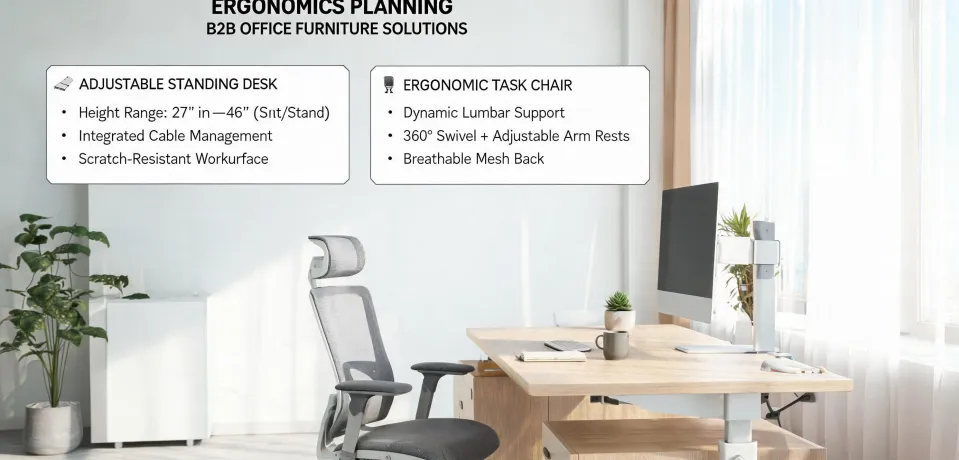
If you've ever managed a furniture procurement cycle for a growing team, you know there's no single desk that works for everyone. The Uplift Desk is a serious contender—it's been Wirecutter's top pick for years, and the customization options are genuinely impressive. But here's the thing: what works for a hybrid team of five doesn't scale for a department of fifty, and what saves you money today might cost you in labor tomorrow.
Which Scenario Are You In?
I've been managing procurement for a mid-sized SaaS company for about six years now—roughly $180,000 in cumulative office furniture spending across multiple rounds of hiring. After comparing 8 vendors over 3 months when we outfitted our second floor, I built an internal cost calculator to track TCO. The short version? The "best" desk depends heavily on three variables: your team's usage patterns, your office's physical layout, and your tolerance for maintenance.
Here are the three most common scenarios I've seen. Read through them—one will probably sound familiar.
Scenario A: The Standard Standing Workforce
This is the most common setup. Most of your team sits at their desks for standard 8-hour shifts. They want to stand for maybe 2-4 hours per day. Budget is a factor, but not the only one—you need reliability and a reasonable warranty.
My recommendation: Go with the Uplift V2 in standard laminate or bamboo. The V2 is their workhorse model—stable enough for dual monitor setups, and the standard frame has a solid track record. I wouldn't spend up for the commercial series unless you have specifically heavy users or 24/7 operations.
One thing I learned the hard way: when we ordered 30 V2s in Q2 2024, the quoted price was per-desk, but we didn't account for the labor cost of assembly. We had to bring in a contractor for three days. That added about $1,200 to our total cost. Factor that in.
Should mention: if your team is mostly hybrid and desks aren't used daily, you might not need the extended warranty. We calculated that for our hybrid team, a 5-year warranty covers about 80% of potential failure scenarios. For full-time in-office teams, go with the 10-year.
Scenario B: The High-Density / Heavy Storage Setup
Your team runs dual or triple monitors. They need serious storage—file cabinets, keyboard trays, maybe a CPU holder. You have limited floor space and need to maximize every square foot.
My recommendation: The Uplift L-shaped standing desk is your best bet. But here's where I'd push back against common advice: don't get the curved corner unless you have a specific workflow reason. The straight corner gives you way more usable surface area for the price. (Should mention: the L-shaped requires at least 72 inches of corner space. We had to rearrange an entire floor plan to fit three of them in one row. Measure twice.)
For storage, skip the CPU holder if your team uses laptops with docking stations. We ordered CPU holders for everyone in 2023 and half of them are sitting unused. The file cabinet add-on, on the other hand, is seriously worth it. It matches the desk height perfectly and saves desk space.
Biggest hidden cost I've seen: the L-shaped desks are heavier—about 30-40% more shipping weight per unit. We didn't account for the freight surcharge. Total surprise cost: about $450 for our order of ten.
Scenario C: The Space or Budget-Constrained Team
You have limited floor space, a tight budget, or both. Maybe it's a small office, a co-working setup, or a department that doesn't need full standing desks.
My recommendation: Uplift desk converters are a solid choice here. They're way cheaper than a full desk and take up zero additional floor space. I've tested the V2 converter, and it's stable for single-monitor setups.
That said, I have mixed feelings about converters for heavy use. On one hand, they're a low-commitment way to get standing capability. On the other, I've seen users complain about the mechanism feeling less smooth over time. For a team of less than 10 with moderate usage, they're fine. For a high-traffic area, go with the full desk.
Take this with a grain of salt: our team of 12 using converters for about 18 months reported no failures, but the adjustment mechanism did feel less fluid after about a year. We had one unit that needed a replacement gas spring—covered under warranty, but it took about a week to resolve.
How to Tell Which Scenario Is Yours
Still not sure? Here's a quick heuristic I use when helping our department leads decide:
- If your team sits 6+ hours per day and you have standard office furniture budgets → Scenario A: V2 standard frame
- If your team handles heavy equipment (3+ monitors, multiple peripherals) or you're outfitting a corner-heavy floor plan → Scenario B: L-shaped
- If your budget is under $800 per desk or you have exactly zero floor space to spare → Scenario C: Converter
I've only worked with medium-scale orders (10-50 desks at a time) for software engineering teams. If you're furnishing a law firm or a hospital, your priorities might shift—different industry, different wear-and-tear patterns. Don't hold me to these exact recommendations for enterprise-scale deployments.
One last thing: whatever scenario you're in, I'd seriously recommend ordering a single desk first to test with your team before scaling. We did that with the V2 and discovered we needed different cable management options than we'd planned. Saved us from a $2,000 reorder mistake.
Pricing as of February 2025. Uplift Desk's own site is the best source for current rates—they change periodically. Verify current pricing before ordering.
Oh, and don't forget to account for taxes and shipping in your TCO. I learned that one the hard way. Twice.

Discuss this article with a workspace planner