The Question Isn't Price. It's What You Don't See.
I manage office setups for a mid-sized tech company. In the last four years, I've kitted out three full floors, handled dozens of rush furniture orders, and replaced more fixed-height desks than I care to count. When a department head asks, "Should we go with Uplift desks or just stick with the standard fixed-height stuff?" — it's never about the sticker price.
The real question is: Which one costs you more over the next three years?
Here's the thing: I've made the mistake of buying the cheaper option before. And I still kick myself for not doing the math upfront. So let's break it down across the dimensions that actually matter when you're managing a budget and a team.
Dimension 1: Space & Desk Configuration
This is where most people start — and stop. A standard 60" x 30" rectangular fixed desk vs. an Uplift V2 standing desk in the same size. Floor space is identical, right? Not quite.
The fixed-height desk: You get what you get. There's no adjustment. You order a 30" depth, and that's what sits on everyone's floor. If someone needs a corner unit or a 72" L-shape, you order a separate model.
The Uplift desk: You can configure the same frame with different top sizes and shapes. Need a curved corner for a collaborative workspace? That's a single desk order, not a custom job. Want laminate instead of bamboo for easier cleaning? That's a dropdown selection, not a different SKU.
Here's the kicker: I once ordered 15 "standard" fixed-height desks for a new team. Three of them came back within a month because the users wanted L-shaped units. We paid restocking fees and shipping both ways. Total waste of about $900 in a rush to get the office ready for a client visit.
Verdict: Uplift wins on flexibility. If you're outfitting a space where users have different preferences or where desk shape matters, the configurable frame is worth the premium.
Dimension 2: Adjustability & Ergonomics
This isn't just about standing vs. sitting. It's about fitting the desk to the human.
The fixed-height desk: Most are designed around the 50th percentile male — about 29 inches high. If your team members are shorter or taller, they're either hunched over or propped up on monitor arms. I've seen people stack books under their desks. It's not great.
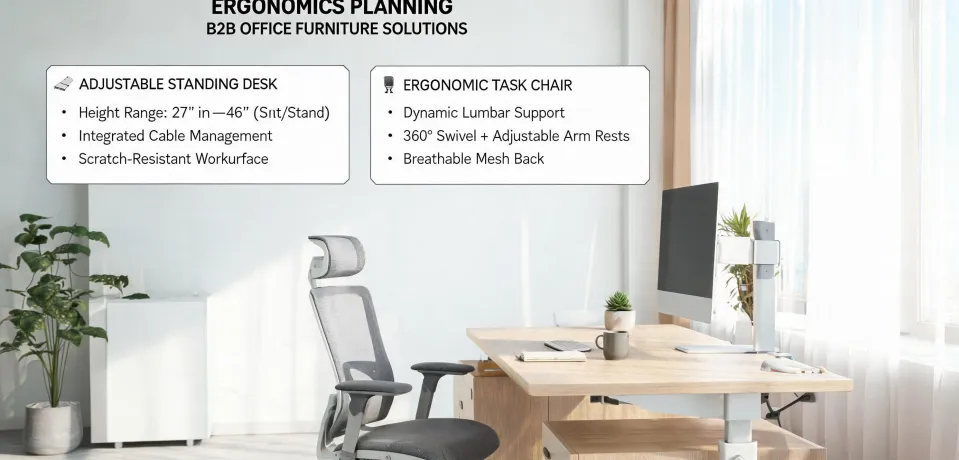
The Uplift standing desk: With a range from about 25" to 51", it fits pretty much anyone from 5'0" to 6'5". The 3-stage frame is especially smooth. And with programmable memory presets, users can switch between sitting and standing heights in seconds.
One of my biggest regrets? Not pushing for sit-stand desks earlier. In 2022, we had three employees file for repetitive strain injuries. That cost our insurance company about $4,500 in claims. The desks that could have helped? At the time, about $800 more per station. We paid more in claims than we would have for the upgrade.
To be fair, a good ergonomic chair on a fixed desk can work for many people. But the data is clear: the ability to change posture throughout the day is associated with lower discomfort (Source: Cornell University Ergonomics Web, based on studies published through early 2024).
Verdict: Uplift wins on adjustability. If your team has a range of heights or you care about long-term health costs (and you should), this is the differentiator.
Dimension 3: The Hidden Costs — Installation, Maintenance, & Resale
This is where the comparison gets interesting, and where I made my most expensive mistake.
The fixed-height desk: Cheap to buy, but you'll likely replace it in 3-5 years. Assembly is straightforward, but they don't hold their value. In Q4 2024, we put eight fixed desks up on a resale platform. We got about $40 each for $250 desks. That's a 74% loss in four years.
The Uplift desk: Initial cost is higher — a V2 frame plus a laminate top runs about $600-$800 depending on size. But these things are built to last. The motors are rated for 50,000+ cycles. The warranty covers 15+ years on the frame. And I've seen used Uplift desks resell for 50-60% of retail after 5 years.
Let's do the math on a 10-employee team:
- Fixed desks: 10 desks at $250 each = $2,500 upfront. Resale after 5 years: $400. Net cost: $2,100.
- Uplift desks: 10 desks at $700 each = $7,000 upfront. Resale after 5 years: $3,500. Net cost: $3,500.
But here's the part I missed the first time: productivity. In my experience, employees with adjustable workstations report fewer sick days and higher focus. One study from BMC Public Health (based on a 2015 systematic review) found an association between sit-stand interventions and reduced back pain. Back pain is the leading cause of workplace disability globally (Source: The Lancet, 2018).
Verdict: Uplift wins on lifetime value. If you plan to keep the desks for 5+ years, the extra upfront cost is offset by higher resale and lower health-related costs. But if you're outfitting a short-term rental or have a tight budget, fixed desks are cheaper right now.
Dimension 4: The Hidden Space You Didn't Realize You Needed
This is where the Uplift curveball comes in.
A few months ago, I was helping a client plan a new conference room. They wanted a large standing desk for a team of four. Their first instinct was to buy four separate desks. But the Uplift V2 comes in widths up to 80 inches, and the L-shaped options can actually maximize corner space.
A dedicated standing desk with a corner curve can fit three monitors and a laptop comfortably in a 6x8 foot footprint. Try doing that with four fixed desks. You'd need twice the floor space.
That's a win for real estate, especially in expensive office markets. According to CBRE (based on Q1 2025 data), average office rent in major U.S. cities is about $35 per square foot per year. If a standing desk setup saves you 40 square feet vs. individual fixed desks, you're saving $1,400 per year in rent alone.
Verdict: Uplift wins on space efficiency. If your office is tight on square footage, the single-desk-at-scale approach is a hidden cost saver.
So What Should You Choose?
I can't tell you which is "better" without knowing your team, your budget, and your timeline. But here's how I'd decide:
Choose Uplift if:
- Your team has a mix of heights (more than a 4-inch difference).
- You're planning to keep the desks for 5+ years.
- You care about long-term health costs (insurance premiums, sick days, injury claims).
- You value flexibility in desk shape or size (L-shapes, corner units).
- You can budget for the higher upfront cost.
Consider fixed-height desks if:
- Budget is the absolute bottleneck and you need desks today.
- Your team is mostly the same height and doesn't plan to change roles.
- You're outfitting a short-term space (e.g., a 1-year rental).
- You don't mind replacing them in 3-5 years.
Look, I've been on both sides of this equation. I've rushed cheap desks into an office and regretted it. I've also ordered Uplift desks that took a few extra weeks on the custom top but paid off in the long run. The truth? Most of the time, the right answer is the standing desk — but only if you factor in the full cost picture.
Prices as of January 2025. Verify current pricing at upliftdesk.com.

Discuss this article with a workspace planner