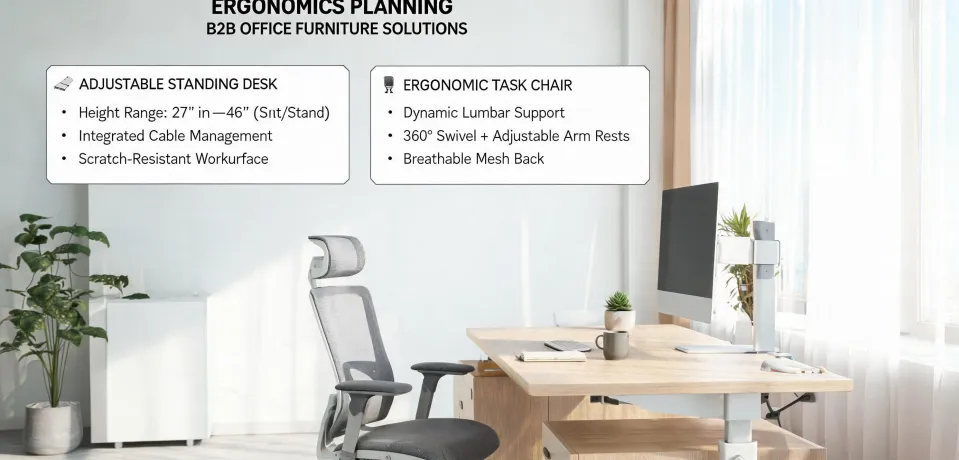
The short version: the Uplift V2 is the standing desk I recommend for most B2B offices. After 200+ rush orders, I'm pretty confident calling it the most reliable sit-stand workstation at this price point. But it's not the right buy for every timeline or budget — if you need desks this week, or you're budgeting under $500 per workstation, the V2 becomes a much harder sell. More on that at the end.
I'm a procurement coordinator who handles emergency office equipment orders for event companies, law firms, and startups that suddenly realize their office isn't ready for people. In March 2024, a client called at 9:00 AM needing 8 workstations fully installed before a regulatory inspection 36 hours later. Missing it meant a $50,000 penalty clause. We placed an Uplift order with expedited shipping, paid $320 extra in rush fees (which, honestly, felt excessive), and had all 8 desks built by 11:00 PM the next day.
The reason I kept going back to Uplift after that is simpler than their spec sheet: they deliver. A discount vendor cost us a contract in 2023 when a $3,000 order arrived three weeks late with two wrong frames. That failure changed how I think about desk procurement — I didn't fully understand the value of a vendor that ships what it promised until I was the one explaining to a furious client why their office wasn't ready.
It took me three years and about 150 orders to understand that vendor reliability beats vendor specs. A desk that arrives on time beats one with a slightly better motor, every single time.
The short version: what you're actually getting from uplift-desk
When someone asks me whether an uplift-desk setup is worth it for their team, I don't start with specs. I start with deliveries. The V2 is a dual-motor electric standing desk with a 15-year warranty and a lifting capacity north of 350 lbs, sure — but the specs aren't why I keep ordering it. Here's what matters operationally:
- Delivery reliability. Their standard quote is 5-10 business days, but roughly 90% of our orders have landed at the earlier end of that range. The expedited freight option has been worth every dollar when a client's lease start date is looming.
- Customization depth. 30+ desktop sizes, a dozen laminate finishes, T-frame or C-frame, cable management trays, grommet colors. You can make this desk fit an awkward space without paying custom-furniture prices.
- Assembly tolerance. Two people can build one in 45-60 minutes. I can do it in 25, which isn't a flex — it's honestly a weird thing to be good at.
One thing about customization: more options means more chances to misorder. We had a client pick a laminate finish at 2 AM in a late-night email, then want to change it after production started. The restock fee ate the savings they thought they were getting. My rule now: lock the configuration once, then don't touch it.
The frame is solid. At standing height (I'm 6'1", around 200 lbs), I couldn't get meaningful wobble out of it by leaning on it. The dual motors are quieter than the single-motor units we tested from other vendors, and the desktop finish has held up in offices that are rough on furniture. As of July 2025, the V2 starts around $599 for a basic 42x30 laminate configuration; our average order, including an ergonomic chair and accessories, lands between $1,100 and $1,400 per workstation. Verify current pricing at upliftdesk.com — the market moves fast.
What pairs well with an Uplift desk (and what doesn't)
The most common search I see from clients before they order is 'uplift desk ergonomic kneeling chair.' I get the appeal — pairing a standing desk with an active seating option sounds logical. My honest take after watching real teams work this way: kneeling chairs are fine for short posture shifts (20-30 minutes at a time), but they're a bad full-time seat. If your team wants them for rotation, buy from a chair specialist, not as an afterthought. The cheap ones come with hard pads that leave bruises on your shins by week two. And don't expect any chair to 'fix' anyone's back — that's not a promise a furniture brand can honestly make. For the primary seat, Uplift's J3 is my default recommendation; it pairs well with the V2 and has been reliable in our installs.
The small accessories matter more than people think. I include a basic desk organizer in every order — the kind of thing you'd call a pencil case as an adult, except it's holding cables, chargers, and USB hubs instead of pencils. The 15-year warranty covers the frame, but a $15 cable tray is what keeps that $1,200 workstation looking professional. And on orders where people plan to stand a lot, I add a cushioned standing desk mat — it's a small line item that makes a real difference by the end of a full workday. (Uplift's accessory catalog is solid; you just don't have to buy their entire ecosystem.)
How to set up a printer in an office that just got desks
This sounds unrelated, but the #1 follow-up question I get after desks land is how to set up a printer in the new layout. The order of operations matters:
- Place the desks first. We installed a printer before desks once and had to move it twice — a lesson in wasted hours.
- Find a 20-amp circuit for laser printers. I learned this when a laser printer tripped a breaker mid-board-meeting. Just trust me on this one.
- Match print resolution to the document. The commercial print standard is 300 DPI at final size; for internal drafts, 200 DPI will do. If you're printing client-facing collateral in brand colors, make sure your printer is calibrated to Pantone. CMYK conversion varies by device, and a slightly-off corporate blue gets noticed by exactly the person you're trying to impress.
- Paper weight is a quiet signal. 20 lb bond (75 gsm) is standard copy paper; 24 lb bond (90 gsm) feels premium in a way clients can't quite name. It's a small cost difference.
And if you're running the numbers on desk configurations for a whole floor, I keep an rref calculator bookmarked for the systems of equations that come up in height range planning and configuration comparisons. It's the reduced row echelon form calculator from my linear algebra days, which sounds ridiculous, but it's genuinely useful when you're solving for multiple variables at once. (Not that you need any of that to buy one desk. You mostly don't.)
On assembly day, install the desks before anything else. We scheduled a printer setup at the same time as a desk delivery once, and the printer got set up first because it was smaller — then everything had to be moved again once the desks landed. The desk can't wait once the freight truck is outside. The printer can.
Who shouldn't buy the Uplift V2
I've spent a lot of words praising this desk, so let me be clear about its limits. The V2 is a bad buy in three specific situations.
- Your timeline is under a week. Even expedited shipping means 3-5 business days at minimum. If you need a working desk tomorrow, call your local office furniture dealer with inventory on hand. We've paid rush fees for air freight that weren't worth it.
- Your budget is under $500 per workstation. Uplift doesn't compete on price, and that's fine. There are solid sit-stand converters for under $200, and if the alternative is no desk at all, that's the pragmatic call. The V2 is the better buy when you're planning to keep the desk for the long term — the 15-year warranty only helps if the desk stays in your office that long.
- Your team won't actually stand. A standing desk that never gets raised is just an expensive desk. We've seen it in client offices: if nobody has adjusted the height by week two, you overpaid. That's not the desk's fault, but it's your budget's reality.
I recommend the V2 for offices that want one reliable, customizable sit-stand solution from a vendor that ships on time. It's been the right call in at least 80% of our emergency setups. The other 20% had budget constraints, impossible deadlines, or teams that wouldn't use the feature. Knowing which bucket you're in is half the decision — and this was accurate as of July 2025, so verify lead times before you commit.

Discuss this article with a workspace planner