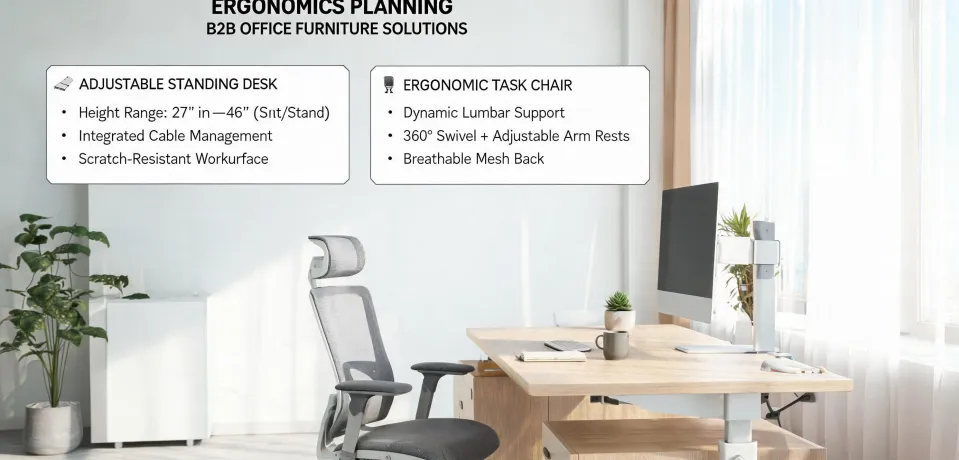
Back in March, our HR director poked her head into my office and said, "We're getting standing desks for the whole team."
My first thought wasn't excitement. It was: how hard can this be? I've been the office administrator at a 40-person accounting firm in Columbus, Ohio for six years. I manage anything with a cord, a contract, or a delivery date. I've bought ergonomic chairs, monitor arms, and noise-canceling headsets. How different could desks be?
Pretty different, it turns out. Researching, pricing, and justifying 36 desks taught me more about our payroll than six years of approving invoices ever did. It also taught me never to say "it's just a desk" in front of our operations team.
The project started on a morning when an email landed in my inbox from a paralegal with the subject line: How do I get my printer back online?
That one took 10 minutes to answer. The desk project took two weeks. Both were worth doing—though only one of them made me look smart in front of the CFO.
My first approach was completely wrong
My initial plan was simple: find the cheapest sit-stand desk that fit a standard 60" x 30" footprint, order enough, and move on.
I also assumed standing desks were basically all the same. A motor, a frame, a top. How much engineering can that require?
Plenty, it turns out. Once I started comparing frame stability, lifting capacity, motor noise, and warranty terms, the whole "a desk is a desk" theory fell apart.
Uplift Desk kept showing up at the top of credible roundups, including Wirecutter's standing desk feature. That got my attention. But what convinced me to call them was reading reviews from people who'd owned the desk for years—not months. Even the negative reviews helped. People were complaining about cord clips and trim alignment. That told me more than any five-star rating: when the biggest issue a customer has is a cable tray, the desk itself is probably fine.
The real V3 price range
Here's where I had to get honest with our COO: Uplift desks aren't priced like office furniture. They're configured like cars.
There's a frame option, a top size, a surface material, a keypad, and about a dozen add-ons. You're not picking a single price. You're picking a range.
The Uplift lineup includes the V2 for standard rectangular desks, L-shaped and curved-corner versions, and the newer V3 line with a heavier-duty frame. The V3 is their premium option, and the price reflects it. For our team-lead stations, we priced V3 curved-corner desks with upgraded tops. Depending on size, frame finish, and keypad, those landed between roughly $1,200 and $1,650 per desk. The V2 desks for our regular workstations came in much lower—around $620 to $820 each. Based on the quotes we pulled in March 2025, that's the honest range to expect: roughly $600–$850 for a well-configured V2 and $1,200–$1,700 for a V3 with options. Prices shift, so verify before you budget.
Before I sent anything to finance, I spent an evening hunting for promo codes. I found a discount calculator on a deal site that compared current Uplift Desk offers side by side. For a single desk, a 5–10% promotional code is a nice win. For 36 desks, there's a better move: I called the sales team, told them the size of the order, and got volume pricing and free freight that beat every public code I found.
The spreadsheet that almost talked me out of it
The turning point came when I built a comparison spreadsheet. A budget import brand had comparable specs at about $1,000 less per desk. Multiply that by 36, and it's real money.
The numbers said go with the cheaper option. My gut said the opposite—not because of brand loyalty, but because I'd been burned before.
Back in 2022, I ordered chairs from a vendor that looked identical to our usual supplier on paper. The chairs were fine. The invoices were a nightmare. Handwritten receipts, no line items, no W-9. Finance rejected the expense report, and I ate the cost out of the department budget. That vendor cost me more than the discount ever saved.
So I called Uplift's support line with a list of questions. The person I spoke to had actually used the desks. They answered honestly about which top scratches easily and which frame made more sense for our taller employees. They even sent physical samples of laminate finishes. Not PDFs. Physical samples. The budget vendor didn't answer the phone for three days.
I went with my gut. Not the most elegant procurement strategy—but my gut was just remembering what the spreadsheet couldn't calculate.
The math that changed the conversation
Our controller is the kind of person who does math out loud. When she saw the total price, she didn't flinch. She asked a better question: "What does this cost per person, per working day?"
She pulled up an Ohio paycheck calculator to estimate state withholding and net pay for our Columbus staff. A first-year accountant costs the firm somewhere around $55,000 a year once you add employer taxes, benefits, and software licenses. That's more than $200 per working day.
A V2 desk—even at the top of its price range—amortized over a conservative seven-year lifespan comes out to less than a dollar per day. A V3 at $1,500? Still about a dollar a day. That's less than the price of a First-Class Mail stamp, which went up to $0.73 in January 2025 per USPS (usps.com/stamps).
If a desk costs less per working day than a postage stamp, the price isn't the problem. The problem is choosing a desk that won't last.
That reframe got finance on board faster than any spec sheet I could have sent.
Delivery, assembly, and the silent win
We ordered on a Tuesday. The shipment arrived about a week later on two pallets. The boxes were beat up, but nothing inside was damaged—which says a lot about how the desks were packed.
Assembly took about 45 minutes per desk with two people. The V3s ran closer to an hour. Printed instructions were included, which sounds obvious until you realize how many vendors ship a desk with nothing but a QR code to a poorly filmed video.
One thing I wouldn't skip: standing desk mats. Standing on a hard floor gets old by day three. We added Uplift mats to the order, and those made the desks much easier to live with.
Within the first week, our employees were using the memory presets constantly. The sit-stand motors hummed at various times throughout the afternoon. Nobody complained about the desks. That's the quiet thing you want in office furniture: silence.
The home office follow-up
What I didn't predict was how quickly the home office requests would follow. Once people used the desks at work, they wanted the same setup for their home office.
For employees buying an Uplift desk for home office use, I gave them some version of this advice: skip the V3 unless you genuinely need a large corner or L-shaped footprint. The V2 is lighter, cheaper, and plenty stable for a typical residential setup. Measure your space first, including ceiling height at full standing position—people forget the desk goes up.
What I'd tell another office administrator
If you're about to take on a similar purchase, here's the short version of what I learned:
- Configure the same way you'd actually buy. Sticker prices mean nothing until you add the frame upgrade, the top material, and the accessories you'll need anyway.
- Call the vendor before you commit. A 15-minute phone call reveals more than 50 reviews. If they're slow, vague, or dismissive when you're about to spend $30,000, imagine what they'll be like when a motor fails.
- Run the math per person, per working day. Big numbers scare CFOs. Small daily numbers don't.
- Read the warranty terms. A longer warranty isn't just protection—it's a signal that the manufacturer expects the product to survive.
I'm also careful not to overpromise the health benefits. Standing desks don't fix anyone's back, and Uplift doesn't claim they do. Their product pages avoid miracle-cure language and stick to what the desk actually does. That's the right approach—and honestly, any claim that says otherwise would need to be substantiated under FTC advertising rules (ftc.gov).
In the end, the desks cost less than I expected and delivered more than I budgeted for. The biggest surprise wasn't the build quality or the warranty. It was how nice it felt to make a purchase decision that the whole company was still happy about two months later.
And the printer? Still goes offline every few weeks. But at least now the person asking me to fix it is standing while they wait.

Discuss this article with a workspace planner