The day I stopped hating standing desks
I've been an office administrator for about 6 years now. I handle all the furniture and supply ordering for a 120-person company spread across two buildings. That's roughly $300,000 annually across maybe 10 different vendors, depending on the year. When I took over purchasing in 2020, the office was still recovering from a hasty WFH setup. Desks were a mess — mismatched heights, cable spaghetti, and a stubborn crew of people who insisted their back pain was just "getting older."
I wasn't exactly a fan of standing desks. I'd seen the glossy marketing. "Boost productivity!" "Eliminate back pain!" It all felt a little too good to be true. And in my experience, things that sound too good to be true usually are. So when a department head came to me saying they wanted standing desks for their entire team, I was skeptical. Actually, I was more than skeptical. I was annoyed.
But by the end of that process — after the research, the vendor calls, the budget meetings, and a very unfortunate incident with a delivery dock — I ended up buying standing desks anyway. Not because I was sold on the hype. Because I finally understood the actual problem.
The surface problem (what I thought it was)
At first, I thought the request was about comfort. People said they wanted to stand because sitting all day hurt their backs. And I figured, okay, a few people want to stand, so let's look into a couple of standing desks for the complainers.
I made the classic mistake of assuming the complaint was the cause.
People think back pain is caused by sitting. Actually, back pain is caused by static posture—sitting or standing in the same position for hours. The causation runs the other way. People who sit all day don't start standing because they want to be healthier. They start standing because their bodies are screaming for a change. The desk is just the tool that allows that change to happen.
Once I understood that, the whole conversation shifted. It wasn't about pampering people with expensive furniture. It was about giving them a way to break out of a position that was actively hurting them.
The real problem was deeper than I thought
So I started digging. I talked to the team (about 15 people in that department). What I found surprised me.
Reason 1: The cost of ignoring it was higher than the price of the desk
Our company doesn't have a formal ergonomics program. We don't have an on-site physio. But we do have a health insurance plan, and we do have a growing number of claims related to back and neck strain. I asked our HR person to pull some numbers. She couldn't give me exact figures (privacy and all), but she said our claims in that category had gone up about 30% since 2022. That's real money.
A single standing desk costs maybe $600–$1,200 (this was in 2024). A single doctor's visit, physical therapy session, or chiropractor co-pay? That adds up fast. For a team of 15 people, buying desks was a cheaper bet than absorbing the health costs.
Reason 2: The “one-size-fits-all” desk was a myth
In my first year on the job (2020), I made the classic rookie mistake: I bought 20 identical desks from a bulk supplier. They were fine — okay quality, reasonable price. But people are not all the same height. They don't all use the same chair. They don't all have the same monitor setup. So those "standard" desks weren't really standard at all. A 6-foot-2 developer and a 5-foot-2 designer cannot share the same fixed-height desk without some serious compromise.
That's where the adjustability of a sit-stand desk became less of a "nice to have" and more of a necessity. It wasn't about standing. It was about fit.
Reason 3: The “standing” part was actually secondary
Here's the part that blew my mind. When I asked the team why they wanted standing desks, the answer was rarely about standing. It was about movement. They wanted to be able to switch positions throughout the day without disrupting their workflow. They wanted to stretch. They wanted to fidget in a productive way.
The desk was just the mechanism. The real need was autonomy over their own body position. Which, honestly, is a pretty reasonable ask.
The real price of not fixing this
Okay, so I was starting to come around. But I still had a practical problem: I needed to justify this purchase to our finance department. And finance doesn't care about comfort. They care about dollars.
Turnover and recruitment
One of the department heads made a point I hadn't considered. They said: "We're competing for talent. Sitting at a cheap, fixed-height desk is a turn-off for the kind of people we want to hire." Anecdotal? Sure. But I've seen it happen. A candidate visited our office and literally asked, "Do we have adjustable desks?" It wasn't the deciding factor, but it was a factor.
The hidden cost of poor equipment
I also looked at what we were spending on desk accessories to compensate for bad ergonomics. Monitor risers (we bought a bunch of those), keyboard trays, footrests, lumbar pillows. All of that stuff adds up. And it's all trying to solve a problem that a properly adjustable desk would solve by default.
The “I told you so” moment
In our 2024 vendor consolidation project, we found that we'd spent about $4,000 on ergonomic add-ons over two years for that one department. That's enough to buy a couple of good standing desks outright. We were paying for a problem we hadn't named.
The solution (and I kept it simple on purpose)
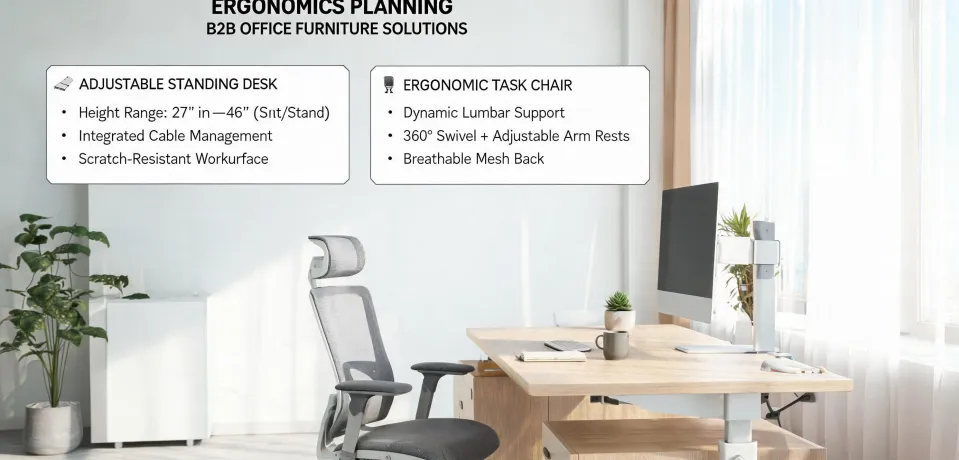
So, after all that analysis, here's what I did. I didn't buy the most expensive standing desks on the market. I didn't buy a single model for everyone. I went with the Uplift Desk V2 for the people who wanted an L-shaped setup, and the Uplift V3 curved corner for the folks who needed more surface area. I ordered a few of the J3 chairs for people with specific needs. I chose Uplift because, frankly, they had the best manual (very detailed, clear instructions), and the build quality felt like it would last. I didn't want a desk that would wobble after a year.
I'm going to be honest with you: if your office is a high-density, open-plan layout where everyone needs to stand at the same height for a uniform look, these desks might not be ideal. They're heavy. They need more space. They're not cheap. But for a team where individual fit matters, they work.
The total investment? About $1,100 per desk, all in (delivery, setup, tax). For 15 desks, that's $16,500. Which is a lot. But when I look at the health claims, the add-on costs, and the turnover risk, it's actually the cheaper option in the long run. We're already starting to see fewer complaints about back pain, and people are moving more. That's worth something.
I don't think standing desks are perfect for everyone. I think they're perfect for teams that value movement and fit. If you're just buying them because you heard they're trendy, you're missing the point. But if you're buying them because you understand the cost of static posture, the value of adjustability, and the real dollars involved in not fixing it? Yeah, that's a decision I can respect.

Discuss this article with a workspace planner