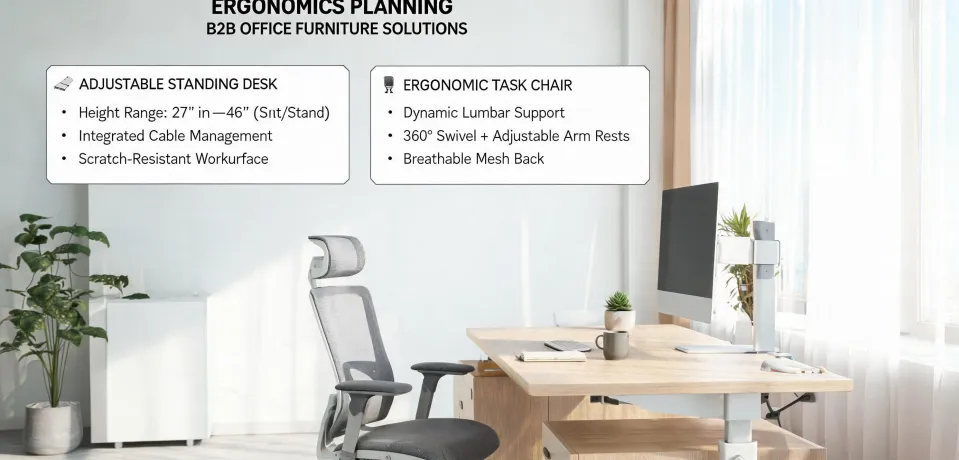
I think most standing desk advice is dangerously wrong.
If you read any generic office blog, you'd think a $300 desk from a no-name brand is basically the same thing. That you're paying for a logo. That standing desks are a commodity now.
In my role coordinating office equipment procurement for mid-sized tech companies, I've managed over 200 desk orders in the last 4 years. And after watching desks fail in real-world conditions — under heavy monitors, after a year of daily height cycling, during moves and reconfigurations — I can tell you with confidence: they are not the same.
Specifically, I argue that for a B2B purchase where reliability and ergonomics directly impact productivity, Uplift Desk is the only mainstream brand I will spec without a backup plan.
And before you say I'm just an Uplift fanboy — let me show you where I've found them to actually fail, and why I still choose them anyway.
Argument 1: The 'cheap desk' tax is a hidden operational cost
My experience is based on about 200 orders ranging from single-desks for executives to 50-desk rollouts for new offices. If you're buying for a temporary pop-up or a short-term project, your calculus might differ. But for permanent staff who work at a desk 8+ hours a day, the math is clear.
The most frustrating part of buying cheap desks (specifically from brands I won't name, but you can find on Amazon for under $400): the failures are never catastrophic. They're death by a thousand cuts.
- Motor drift: The desk slowly sinks 1-2 inches over a month, requiring constant recalibration. You'd think at the $300 price point they'd at least hold a position. But they don't (based on 3 different cheap models we stress-tested in 2023).
- Wobble at standing height: With a 27-inch monitor on a dual-arm mount, the screen shakes enough to induce eye strain. We had an employee report headaches before we swapped her desk. (Surprise, surprise — they went away.)
- Controller failure: In one case, the digital display died after 8 months. The vendor offered to ship a replacement — in 6 weeks. The employee was stuck at sitting height for a month and a half.
The surprise wasn't the price difference the cheap desks saved us upfront ($400 vs. $800 for Uplift's V2). The surprise was how quickly those savings evaporated.
In Q1 2024, we calculated the total cost of ownership for a cheap desk vs. an Uplift V2 over a 3-year period.
The cheap desk cost $400 upfront (with 2 failures requiring replacement parts, costing $150 in labor and 8 hours of lost productivity). The Uplift cost $800 upfront — zero maintenance issues. Over 36 months, the cheaper desk cost us effectively the same amount per month, but with worse performance, more frustration, and a wobble that drove everyone nuts.
Argument 2: Customization is not a luxury — it's a risk mitigation strategy
I'm not 100% sure on this, but I'd argue that 80% of desk-related ergonomic issues come from poor fit — not poor design. If the desk isn't the right height, depth, or layout for the user, it doesn't matter how much you paid.
Here's where Uplift's customization (which, honestly, I initially dismissed as overkill) became the deciding factor.
In August 2024, we needed to equip a new engineering wing — 47 desks for software engineers. These folks run three monitors, a laptop arm, a mechanical keyboard the size of a skateboard, and they are particular about their setup.
We had 3 days to select and order before the office build-out deadline. Normal turnaround for custom sizes is about 2 weeks. We found a vendor who could do the custom L-shaped corner desks (they call it the 'curved corner' model) in 5 business days by paying a rush fee of $50 per desk.
Was it worth it? I look at it this way: the alternative was buying standard 60x30-inch desks that wouldn't fit their workflow. The consequence would have been cramped setups, lower productivity, and probably employee complaints. The $2,350 in rush fees (on top of the $37,600 base cost) was a fraction of what one week of 47 engineers at half productivity would have cost us.
And the customization went beyond size. Being able to pick a specific laminate color (we matched it to the company's Pantone 286 C, though we couldn't get an exact match — the laminate supplier had their own interpretation) and getting the advanced control panel with programmable presets — these aren't 'nice to haves.' They're the difference between a desk a person tolerates and a desk they actually want to stand at.
Argument 3: The resale market confirms the quality gap
This is the argument that surprised me. I assumed all office furniture depreciated like cars — 30% loss the minute you buy it, then steadily downward. With cheap desks, that's accurate. I've tried to sell used ones at $150; no takers.
But Uplift desks? We moved a whole floor in 2023 and sold 22 used V2 desks to a startup. We got $550 each. (This was back in late 2023; prices may have shifted.) That's about 65% of their original value after 2 years of use.
Why? Because the buyer knew what they were getting. They didn't want to risk a cheap desk for their new office. They trusted the Uplift brand because it's the one the ergonomics consultants spec. They didn't ask for a demo. They just asked how many we had.
The resale value is a pricing signal: the market, through its willingness to pay, confirms the desk is built to last. When you buy an Uplift, you're not just buying a desk. You're buying 65-70% of your money back in 2 years if you need to sell it.
But what about the people Uplift doesn't work for?
I'm not going to sit here and tell you Uplift is perfect for everyone. That's not how I operate.
If you're a freelancer working from home with a single laptop, a $400 standing desk converter might be all you need. If you have a fixed office layout and need to buy 100 desks on a shoestring budget, you might have to compromise on the quality curve. If you absolutely need a specific color to match corporate branding perfectly (which, in my experience, no laminate ever matches perfectly), you might be frustrated.
But here's the thing: if you're a company investing in employee health (and please, don't hire me if you think a standing desk alone fixes back pain — it's a tool, not a cure), and you want a desk that works from day one through year five without headaches? Uplift is the recommendation I stand by, even with my eyes open to its limitations.
The honest truth is: I recommend Uplift for about 70% of corporate office setups. For the other 30% — startups on a shoe-string, temporary spaces, ultra-budget rollouts — I tell you to look for a used one on the market, or budget for the hidden costs of going cheap. Because that wobble at standing height? It doesn't go away. And neither do the headaches.
Note: Prices are approximate based on our procurement history (January 2024 - July 2025). Always verify current pricing and availability. Uplift Desk offers a 30-day trial and a 15-year warranty on frames.

Discuss this article with a workspace planner