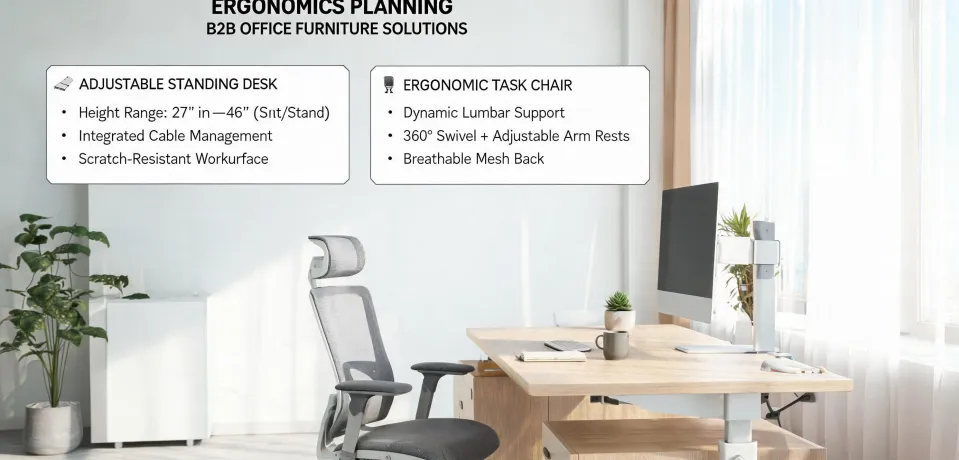
After managing office procurement for four years, I can give you the short version: the $349 standing desk we bought to save money ended up costing $1,150 in repairs, replacement parts, and lost time — more than the Uplift L-shaped standing desk that finally replaced it. If you're picking sit-stand desks for a new office, start by comparing the Uplift 120-degree standing desk and the Uplift L-shaped standing desk against cheaper options, not on sticker price alone, but on total cost over five years.
I'm the operations manager at a 14-person product design studio. I've been handling furniture and equipment orders since 2021, and I've personally documented five significant purchasing mistakes, totaling around $4,200 of wasted budget. I maintain our team's buying checklist so we don't repeat them. This is one of those mistakes.
How our “affordable” standing desk became a money pit
In February 2022, we added two workstations. I assumed all standing desks were basically the same: a motor, two legs, a control box. So I ignored the Uplift desks on our shortlist and ordered a budget brand that looked similar on paper. The price difference was about $200 per desk. That was my initial misjudgment.
The desks arrived quickly. Honestly, the first month was fine. Then the complaints started. The top on one desk began to bow under dual monitors. We added a steel support bracket—$38 in parts plus an afternoon of work. The control box on the second desk died around month seven. Replacement took eleven days because the seller uses a third-party warehouse. The other motor started making a grinding noise when lowering. We paid $180 to a local technician to diagnose it, then another $240 for a replacement motor that we installed ourselves. Add rush shipping fees, and the total extra spend hit $530. That's not counting the 20+ employee hours spent troubleshooting.
The math was painful: $349 + $85 shipping + $530 = $964. If I remember correctly, we then spent another $1,150 on the Uplift L-shaped standing desk in May 2023. So the cheap option ended up costing us $2,114 for the same workspace, not counting the headache.
Everything I'd read about standing desks said “specs are specs.” In practice, the budget desk had a single-stage motor, a particleboard top, and a frame made of thinner steel. The Uplift model we eventually chose had a laminated top over a steel frame, dual motors, and a much sturdier crossbar. They weren't comparable pieces of furniture.
The Uplift L-shaped and 120-degree standing desk difference
We now own both an Uplift L-shaped standing desk and an Uplift 120-degree standing desk. The L-shape is in the corner of our studio; the 120-degree version is tucked into an awkward angled alcove near the entrance. Both were worth the extra money.
Here's why: you can spec them. You choose the exact size, surface material, frame color, and even grommet placement. That level of customization isn't vanity—it means the desk actually fits the room and the work. Our 120-degree standing desk was built to match a 60-inch wall with a 48-inch return. No cheap desk comes in that configuration.
I also learned to care about warranty and support. Uplift's support team actually answers the phone. When we had a question about the controller on the L-shaped desk, someone talked us through the reset in five minutes. That's worth a lot when a desk stops responding.
The conventional wisdom is that a standing desk is a standing desk. After two years of daily use, I'd argue the opposite: the frame, motor, and desktop quality determine whether the desk will last five years or five months.
Value vs. price: the YETI lunch box test
If you're still on the fence, ask yourself this: why do people happily pay $45 for a YETI lunch box when a $12 cooler bag works for a year? Because the YETI lasts for years, keeps food cold, and doesn't need replacing. A standing desk is the same, except you use it far more. In our office, we calculated that the cheap desk cost about $4.20 per workday if you include repairs and downtime. The Uplift desk, once paid off, costs around $0.35 per workday over a five-year lifespan.
You don't need an economics degree to see which is better. If you were using a savings bond calculator to decide whether to invest in a new desk, you'd see that the “cheap” choice has a negative return after three years. Quality amortized over time beats price at the moment of purchase.
We even had a colleague spend 45 minutes trying to figure out how to reset an HP printer while ignoring the back pain from his non-adjustable chair. That's exactly the mindset trap I'm talking about—people fix tiny problems while rationalizing the big purchase that would prevent them.
What I check before ordering now
Motor specs and weight capacity
I look for dual motors if the desk will hold more than a monitor and a laptop. Single motors can fail under heavy loads. If the manufacturer doesn't list the motor rating, that's a red flag.
Desktop construction
A $300 desk may use particleboard with a printed wood grain. A good desk uses a laminated wood core or steel top. You can't tell from photos, so ask for cross-section details or look at independent teardown reviews. Also, don't be swayed by “green” marketing. Per FTC Green Guides, environmental claims like “recyclable” need to be substantiated. We saw one budget desk advertised as “eco-friendly wood” that turned out to be particleboard with a thin veneer.
Shipping and delivery
Budget brands often quote low prices but charge extra for “white glove” service, which still means the driver drops the box in your lobby. According to USPS, a first-class stamp is now $0.73 as of January 2025—small costs add up. In furniture, freight and assembly are where the surprises hide. We paid $85 shipping on the cheap desk and still had to haul it up two flights ourselves.
Warranty and support
Check whether the support line is staffed by humans. The cheapest desk had a 1-year warranty, but replacement parts took two weeks. The Uplift warranty covered the controller for 5 years, and support answered within minutes.
When a cheap desk is actually the right call
To be fair, there are situations where you should buy the cheap option. If you're setting up a temporary office for a six-month project, or your team is fully remote and nobody uses the desk daily, then maybe a $300 fixed-height or budget standing desk is fine. If your budget genuinely doesn't allow the extra $200–$400, I get it. But go in knowing that you're not saving money—you're delaying the payment and gambling on reliability.
Also consider that Uplift has different price tiers. You don't have to choose the top-of-the-line frame. The basic Uplift V series frame with a standard top is lighter on the wallet than the full custom version, and it's still more robust than most generic options.
Uplift wasn't the only premium manufacturer, by the way. I'm not saying every office should buy it. I'm saying that if you compare based on total cost of ownership—not the initial quote—the picture changes dramatically.
So if you're leasing a space for less than a year, buy the cheap desk and don't look back. But if you're planning to stay longer than a year, do the math before you buy. In my experience, you'll never regret paying for quality—you'll only regret the $964 desk that had to be replaced twice.

Discuss this article with a workspace planner