It started with a printer question
Last Thursday at 2:17 PM, my office manager pinged me a question I get at least once a month: "where to buy a printer?"
Seems innocent. But we'd already gone through three printers in 16 months. Each time, whoever needed one bought the cheapest option that could ship next-day. Nobody tracked what those printers actually cost — the five-hour IT troubleshoot sessions, the replacement toner, the one that died eight months in because it wasn't built for a 30-person office.
I've spent six years tracking every purchase order, flagging hidden fees, and building the cost spreadsheets nobody asks for. Yes, I have a folder literally labeled "office equipment mistakes." When you live in those numbers, you start noticing patterns.
So when the same office manager asked me to help spec out sit-stand desks for the team, I had a feeling we were about to make a much bigger version of the same mistake. Standing desks are not a $200 printer. For our company, this would be a five-figure line item. If I focused on unit price without thinking about what happens after delivery, we'd be living with that choice for years.
The comparison
I started the way most procurement people do — with public reviews. "Uplift Desk" kept appearing in every serious standing desk roundup I found, including Wirecutter's best standing desk coverage, where Uplift has been a consistent pick across multiple updates. That carried weight with me. But reviews only tell you so much about the years after the unboxing.
So I built an eight-vendor comparison matrix with the columns that actually matter for long-term cost:
- Base pricing for equivalent specs (60×30, dual motor, laminate top)
- Shipping and white-glove assembly quotes
- Warranty terms — not just length, but what's actually covered
- Replacement part pricing and availability
- Complaint patterns from owner communities and repair forums
What I found surprised me. The budget options were 30–50% cheaper on paper. But they also had thinner frames, one-year warranties at best, and replacement parts that were nearly impossible to find. Interesting. Not decisive yet — but enough to keep me digging.
Not everyone needed a full desk
Early on, I surveyed the team. A surprising number of people loved their existing desks and just wanted the ability to stand for a few hours a day. For them, a full replacement wasn't just unnecessary — it was a loss. They'd customized their cable management, their monitor arms, their everything.
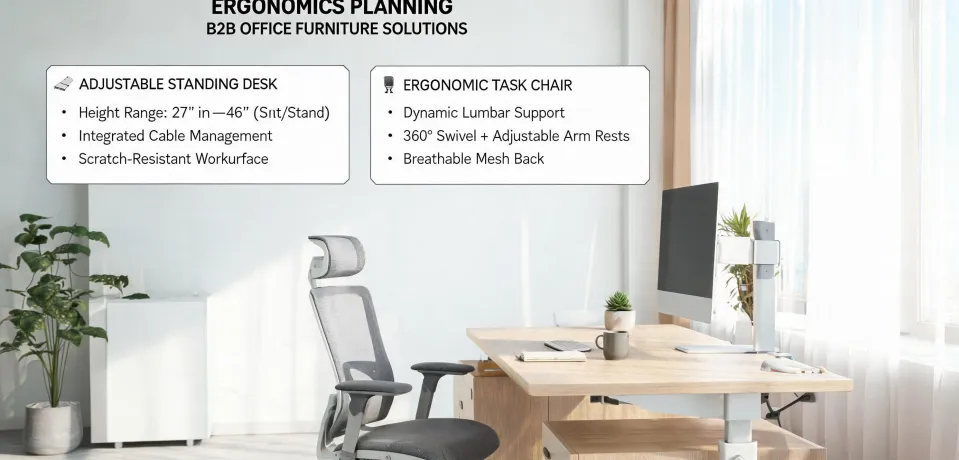
That's when I found the uplift desk atx standing desk converter. It's basically a height-adjustable platform that sits on top of an existing desk. People get the sit-stand benefit without learning a whole new workstation. Since the converter uses the same control system as the full Uplift desks, our IT team could support one ecosystem instead of five.
The plan split into two tracks: full Uplift desks for most of the office, and ATX converters for the folks who would've fought me before letting me touch their setups.
The whiteboard nobody asked for
Then our operations lead mentioned wanting a dry-erase surface for impromptu planning sessions. I'd seen the uplift desk whiteboard listed as an accessory — a whiteboard that mounts to the desk frame and moves with it — and, honestly, my first reaction was that it sounded like a gimmick. A whiteboard is a whiteboard, right?
But from a procurement angle, the math shifted. Wall-mounted whiteboards would mean another vendor, another installer, another separate invoice. With the Uplift accessory, the bracket bolts to the same frame that's already on-site. No extra shipping windows. No coordination overhead. For four units, the total cost of ownership came out lower than buying from a different supplier.
It also turned out to be a hit. But I'm getting ahead of the story.
Life interrupted
Look, no procurement story is clean. The same weeks I was buried in spec sheets, a friend who runs a medical billing practice texted to ask if I knew a good RVU calculator. I didn't, and I had to ask what RVU meant. She explained: Relative Value Units — the standard way Medicare compares the complexity of medical procedures. Her team needed it to benchmark provider compensation fairly.
The conversation stuck with me because it's the same work I do every day. You can't assign a cost before you agree on how to measure value. For her, RVUs. For me, total cost of ownership. Get the calibration wrong, and every decision downstream goes wrong with it.
There was also the afternoon my junior analyst shared his screen during a meeting, and the whole room caught a glimpse of a Palworld breeding calculator sitting in one of his browser tabs. He was supposed to be verifying warranty claims across our vendor list.
I could've been annoyed. But at the end of that week, he handed me a spreadsheet that caught a warranty loophole I'd missed. A "limited lifetime warranty" that expired after three years. Buried in the terms and conditions of the second-cheapest vendor, deep enough that I'd completely skimmed past it. So maybe his brain was working fine all along. I just needed him to point it at the right spreadsheet by Friday.
When the spreadsheet and my gut disagreed
Here's the part I'm not proud of: my own comparison sheet didn't point to Uplift.
On pure unit price, three budget brands "won." The difference added up to about $9,000 in initial savings. That's real money. But every time I looked at the red flags — thin frames, one-year warranties, unavailable replacement parts — something felt off.
The numbers said "save the $9,000." My gut said "you will eat that $9,000 later, plus interest."
So I built the model that settled it: a 10-year total cost projection. I assigned conservative failure probabilities based on complaint patterns in owner forums, and added the cost of replacing a desk that's physically installed in a working office. That includes labor, furniture disposal, shipping for a replacement, and the lost productivity of an employee working from a folding table for a week.
Once you run that math, the cheap option's savings evaporate around year three. Uplift's 15-year frame warranty isn't just a piece of marketing — it fundamentally changes the lifetime equation.
Looking back, I should have built the lifecycle model from day one instead of three weeks in. At the time, I was so focused on unit prices that I forgot the entire point of the exercise: cost over time, not cost on the invoice.
What I actually approved
In the end, I signed off on this:
- 16 Uplift V2 desks (60×30, laminate tops, dual motor)
- 5 L-shaped Uplift desks for engineering and operations
- 3 curved-corner Uplift desks for team leads who wanted the extra surface area
- 6 ATX standing desk converters for the "don't touch my desk" crew
- 4 Uplift whiteboard mounts
- 2 Uplift ergonomic chairs (the J3 and Pursuit models) for employees with ongoing back issues
Total: about $31,000 delivered. Prices as of July 2025; verify current rates if it matters to you.
Did that number make me wince? Honestly, yes. Part of me thought about what $31,000 could buy elsewhere. But another part remembered the printer folder. I wasn't going to repeat that lesson at a hundred times the scale.
Six months later: the numbers that count
Because I'm me, I tracked everything.
- Warranty claims: zero. As in, none.
- Productivity complaints: zero. One minor question about assembly instructions in the first week, resolved with a single phone call.
- ATX converter usage (self-reported by the team): an average of three times per day, per person.
- Whiteboards: used daily by the operations team. The "gimmick" I doubted turned out to be the accessory with the most unprompted positive feedback.
I'm not going to tell you Uplift is the right answer for every office. If you're a five-person startup with a short lease, the lifetime math might point somewhere else. Honestly, I'd still tell you to run the 10-year TCO model before you decide.
Here's the framework, since I promised it:
- Set your horizon. How long do you actually plan to own this equipment?
- Compute full lifecycle cost. Purchase + shipping + setup + maintenance + odds-weighted replacement.
- Read the warranty fine print. Check for "lifetime" guarantees that expire after three years.
- Find a tiebreaker when your gut and data disagree. Pick an independent metric that settles the argument.
And the printer question from the beginning? We ended up buying the same model we'd already been using, because the last thing we needed was a new support headache to save sixty dollars. Same principle that drove the desk decision: the real cost of something shows up after you buy it.
That's what I wish more people understood about procurement. It's not about being the person who says no. It's about being the person who notices what the invoice doesn't say. The purchase is the beginning. The years after are where the numbers actually matter.

Discuss this article with a workspace planner