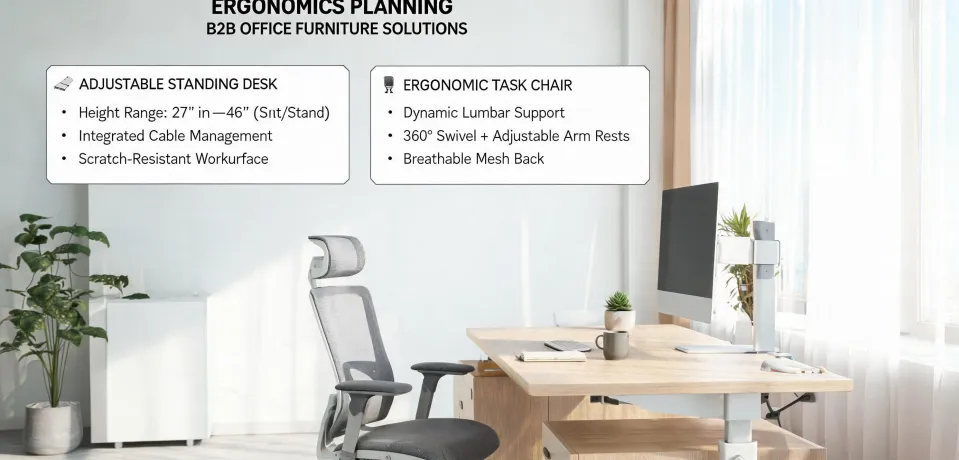
There are two kinds of standing-desk guides: the ones that crown one model as the best for everyone, and the ones that list every option without telling you what to do. I'm going to avoid both. In my role coordinating office furniture orders for a mid-size dealer in Austin, I've handled roughly 60 rush projects over the last seven years. The short version of what I've learned is that the right Uplift Desk depends on your scenario, your deadline, and the total cost of getting it installed and supported.
Use total cost before you use the sticker price
Base price is the first layer, not the last one. Add freight, liftgate delivery, white-glove assembly, cable management, monitor arms, returns, and the risk of a desk that doesn't fit because nobody measured the room. When I see finance teams punch quotes into a mean calculator to decide which vendor is cheapest, I cringe. A single rush freight quote can push the arithmetic mean up to a number that doesn't match any actual vendor. Sort the quotes and look at the median instead. That's usually the better benchmark.
That's also why I don't fixate on the Uplift V3 standing desk price before looking at the whole setup. The V3 frame is heavier and more stable at standing height. It's worth a higher total cost for a tall user with three monitors who stands several times an hour. For standard administrative work, a V2 frame is often enough, and the money saved is better spent on an ergonomic chair and a standing desk mat.
The three Uplift desk scenarios I run through on every order
Most requests fit one of three patterns. I've listed them below, and then I'll walk through each one.
- Scenario A: You're equipping a team or a whole office.
- Scenario B: You need a corner, L-shaped, or curved-corner workstation.
- Scenario C: The budget is tight and you can't buy every piece at once.
Scenario A: Outfitting a team, not one person
When a company orders ten desks at once, consistency matters more than peak specs. Pick one frame, one desktop size, one finish, and one cable-management path. Spare parts and support get complicated when every workstation is different.
For most team rollouts, the V2 is my default because it's less expensive and easier to install. Reserve V3 for workstations where people are tall, run multiple monitors, or stand for long periods. For everyone else, put the extra money into chairs, monitor arms, and anti-fatigue mats.
Let me give you a real deadline story. In March 2024, a client called 36 hours before their lease inspection after the vendor they'd paid disappeared. We found eight stock V2 desks at one local dealer, four more through next-day freight, paid about $360 in rush shipping, and assembled them that night. The project ended up costing roughly $700 more than a normal no-rush version. The alternative was losing a lease clause that would have cost far more. That's what I mean by total cost: the cheapest quote is not the cheapest option if it misses the deadline.
Scenario B: L-shaped and curved-corner workstations
For a corner office or a dual-monitor setup, an L-shaped Uplift Desk gives you a lot of usable surface. The V3 curved-corner version does the same thing with a more comfortable middle area. I went back and forth for about a week when we were setting up our design studio. The L-shape fit cleaner against two walls. The curved top was better for sit-stand work because I didn't have a sharp edge pushing into my forearms. I chose the curved version and then missed one measurement: the controller on the left side and the cable tray underneath. What I mean is, I measured the footprint but not the working space around the desk. That mistake cost $260 in extra relocation work. If you're ordering an L-shaped or curved-corner desk, measure the ceiling corners, baseboards, power outlets, and the path the desk will travel through.
If someone searches for 'Uplift desk ergonomic chair,' they're usually thinking about the whole workstation, not just one product. That's the right instinct. I don't think every chair has to be the same brand as the desk, but Uplift's J3, Facet, and Pursuit chairs all fit the same durability and adjustment ranges I look for. The important part is matching the chair, monitor height, and desk surface to the person who uses them.
Scenario C: The budget is tight
This might sound odd coming from someone who has installed a lot of desks, but the ergonomic chair comes before the standing desk. A standing desk changes posture, but a chair carries your body for most of the day. If the only option is a good standing-desk frame with a bad chair, I'd buy a good chair first and add sit-stand capability later.
For a workstation budget under $1,000, start with an ergonomic chair and monitor arms. If the budget is over $1,500, an Uplift Desk paired with a good chair makes sense. If you're outfitting shared spaces and can't afford sit-stand for every station, buy one or two Uplift V3 desks for the people who most often complain about back and neck discomfort, then fill the rest with good chairs and scheduled movement reminders. A standing desk isn't a medical device, and I won't pretend it cures back pain. It's a way to avoid staying in one locked posture all day.
The same total-cost logic applies to the rest of the office. When someone asks 'where to buy a printer near me,' the nearest retailer isn't always the right answer. A printer's real cost includes toner, support, and what happens when it jams during an important print run. I'd rather spend an extra $150 with a local dealer who can service it than save $150 at a big-box store and lose an afternoon.
How to tell which scenario you're in
Answer these three questions before you order.
- Is this one workstation or many? Many people in similar roles means Scenario A.
- Does the desk need to fit a corner, a dual-monitor setup, or a long sit-stand reach zone? That points to Scenario B.
- Can you comfortably buy both a desk and a chair today? If not, run Scenario C.
And one more warning. When your finance team wants to delay the purchase, don't turn an office desk into an investment debate. A savings bond calculator can show you what $12,000 might become in ten years, which sounds persuasive until you realize the desk is a tool your team uses every workday. I don't have hard data on lost productivity, but I can tell you what I've seen anecdotally: offices that delayed ergonomic purchases to save money usually ordered the same desks and chairs the next year, after paying rush freight or temporary rental costs. Run the total-cost calculation for your scenario, choose the option that fits the actual users, and don't let one low sticker price erase the cost of delays. That approach has worked for me on more than 60 projects, and it'll work for your office too.

Discuss this article with a workspace planner