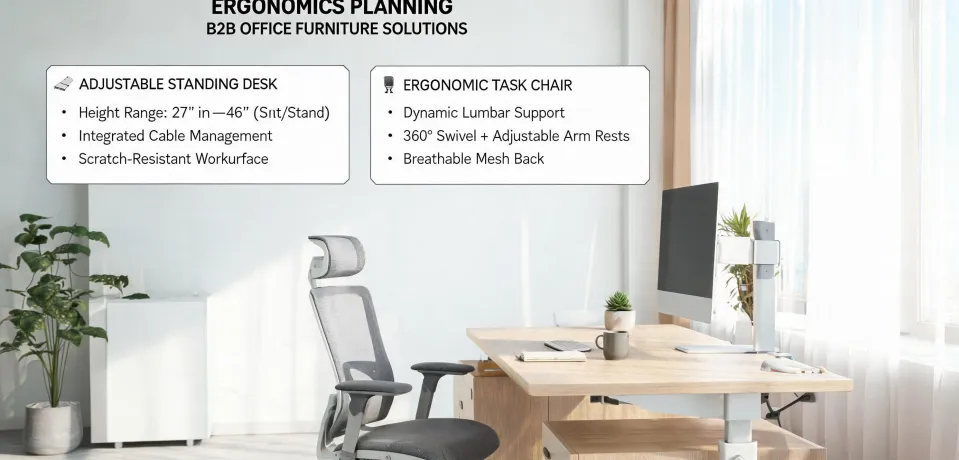
Last March, our operations director dropped a floor plan on my desk and circled the entire south side of the fourth floor. That is where finance and the creative team work—eighteen people, most of whom had been complaining about back and neck pain since January. The refresh was part of a company-wide effort to improve workstations, and it was my job to handle the purchasing side. We needed sit-stand desks. The only real question was how to buy them without making an expensive mistake.
By title, I am an office administrator. For the past five years, I have handled purchasing for a 180-person marketing firm. That means 60 to 80 orders a year, eight or nine active vendors, and a budget that answers to both operations and finance. I am comfortable with catalogs, purchase orders, and delivery schedules. I am not an ergonomist, and I have never claimed to be one.
I started the way I start most projects: online research. The Wirecutter best standing desk 2025 recommendations kept mentioning Uplift, mostly because the frame and motor felt stable at standing height. But the articles only took me so far. I also called a dealer who asked a question I had not seen in any review: who is the shortest person using it, and who is the tallest? That changed the conversation from brand names to actual measurements and helped me match the desk height range to our team.
I almost made two mistakes during that phase. The first was assuming all sit-stand models worked the same way. The second was trusting that a heavy price tag would solve every issue. The dealer pointed out that a tall person and a short person have different needs, and a heavy desk with the wrong range would be as annoying as a cheap one. It took one phone call to understand what thirty articles had not made clear.
By the end of my research, I had a floor plan, a spreadsheet, and a purchase order: eight Uplift V2 desks, two L-shaped Uplift desks for the creative leads, and one Uplift standing desk converter for an employee who already owned a high-quality fixed desk and only wanted the option to stand. I also added a dry erase board to the project because our main conference room board was stained beyond the point of saving.
I will be honest: the total made me pause. Electric standing desks with solid tops are not a cheap line item. But the people sitting on that floor had been asking for relief for months, and the desk is the one surface they touch every day. I decided to treat the quality issue as part of the spec, not an upsell.
The Uplift desks arrived on a Tuesday. I scheduled the install for a week when most of the fourth floor was remote, so the crew had room to work. The delivery team was professional, which made the next part more surprising.
They laid out every desktop, checked the parts, and assembled the first few units without issues. Then I stepped out for a late-morning call. When I came back, one installer had used a permanent marker to mark where he planned to attach a monitor arm clamp. He had not placed painter's tape underneath. In his defense, he stopped as soon as I asked. But a thin black line was already sitting on the maple surface.
I stared at that line for a full five seconds. Wood desktops are not like a dry erase board; you cannot just wipe them and start over. I pulled out my phone and typed how to get permanent marker off wood while trying to sound calm.
Isopropyl alcohol was the first recommendation on every page. I almost grabbed a cleaning wipe and went for it, but I stopped because I did not know if the desktop had a sealed finish or an oiled one. I called James, our facilities manager. He has forgotten more about wood finishes than I will ever know. He tested a spot under the desk, then told me to use 91 percent isopropyl alcohol on a soft cloth, blot rather than rub, and avoid magic erasers because they can dull a sealed surface.
Ten minutes later, the mark was gone. (Should mention: after that, I required painter's tape on every remaining desktop. The first mistake was mine—I had not specified the procedure.)
The same week, I had to face the printer problem I had been avoiding. Our old laser printer was from 2016, and finance used it for client letters and expense reports. It jammed often enough that the accounting manager had stopped being patient about it. I know how to buy office supplies, but I do not know printer economics, so I asked our network admin to walk me through it.
He suggested an Epson EcoTank printer. I winced at the upfront price, but he showed me a cost-per-page comparison and explained that an ink-tank system made more sense for our volume than another laser cartridge machine. Six months later, finance has not complained once, and I have not ordered any printer supplies.
The dry erase board taught me a smaller but related lesson. I ordered a standard board for the marketing team. They need a wall where they can sketch campaign timelines, so the purchase made sense. What I missed was that they also wanted to attach cards with magnets. The marketing manager did not know to ask for a magnetic board, and I did not ask how they would use it. The replacement arrived two weeks later.
That delay made me step back and think about the assumptions I bring to an order. A desk is not just a table; a board is not just a white rectangle; a printer is not just a box that prints. Each product has variants that matter only when you know how it will be used. That is exactly why I need to ask.
By the end of the refresh, I had a clearer sense of my own limits. I am not the expert on ergonomics, printer technology, or wood finishes. Pretending otherwise creates expensive problems. My job is to find the right expert, ask smart questions, and make the purchase process simple for everyone else.
This was not how I thought about procurement when I started in 2020. Back then, the conventional advice said a good buyer could research any category and make an informed decision alone. After five years and probably 300 orders, I have learned that independent research matters, but it works best alongside the people who use and maintain the products every day.
The same logic applies to vendors. If a supplier says they can do everything, I hear risk. If a supplier says something is not their specialty but points me to someone who does it better, I hear trust. Earlier this year, a furniture dealer did exactly that. He told us he did not carry Uplift and suggested we call them directly. He lost that particular sale, but he made our shortlist for the next project.
Today, the Uplift V2 desks are still in use. The L-shaped desks are holding up, and the Uplift standing desk converter is still helping that employee split her time between sitting and standing. The Epson EcoTank printer is running quietly, the magnetic dry erase board is covered with campaign cards, and the permanent marker is back in the drawer where it belongs. I still do not know how to fix every office problem on my own, but I now know exactly who to call.

Discuss this article with a workspace planner