The 4:30 Call
A medical office manager called me at 4:30 on a Friday in March 2024. Her head nurse had been dealing with lower back pain for three weeks. Two other staff members had started complaining about neck tension that they blamed on "the computers." The practice was up for a state licensing review in ten days.
"I think we need new chairs," she said.
That sentence is the most common opening I get in this line of work. In my role coordinating furniture and ergonomics support for offices, I've handled 200+ urgent workspace requests over the past seven years — same-week setups for new clinics, emergency reconfigurations before corporate move-ins, and more "we need this solved by Monday" calls than I care to count. The details change. The first line rarely does: we need new chairs.
Nine times out of ten, the chairs are fine. The setup isn't.
That March 2024 call changed how I think about chair complaints. I used to treat "it's the chair" as a straightforward technical issue — check the model, check the warranty, write up a replacement recommendation. Now I see it differently: most people aren't asking for new furniture. They're asking for someone to help them use what they already have. They just don't know how to put that request into words.
The Adjustment Nobody Makes
Here's a number that surprises even me after years in this work: most office chairs have at least five adjustments — seat height, seat depth, lumbar support, armrest position, and backrest angle. Some have eight or nine if you count tilt-lock and forward-tilt options. In my experience, the average user touches exactly one: the pneumatic height lever. A meaningful number of people don't know the other levers exist.
Why does this matter? Because "comfortable for the first 20 minutes" is not the same thing as "aligned for an eight-hour shift." What I mean is that you can sit in a misadjusted chair for a while and feel perfectly fine. Your body quietly compensates. You slump. Your shoulders round. The lumbar support — the curve that's supposed to press into the small of your back — ends up flattened against the backrest near your mid-back, doing exactly nothing. But by hour six, the compensation shows up as real pain. And because the discomfort comes on gradually, you blame the chair. Or your posture. Or your age.
It's rarely any of those things.
Take tilt lock: I've found chairs with the tilt lever clamped down and locked, which means the backrest doesn't move a single degree when the user leans back. The seat pan slides forward and back, but nobody slides it, leaving the seat edge digging into the back of the knees. Armrests sit unaligned — one higher than the other — because they were installed by a facilities person in a hurry and never touched again. I once worked with an office manager who said, in total seriousness, "I've been sitting in this chair for six years and I never knew that lever was there." She was pointing at the lumbar control.
That's not a chair problem. That's an instruction problem.
To be fair, furniture doesn't ship with a manual taped to the seat. And "set it up the way the factory intended" isn't obvious to someone who was hired last week and is still learning the job. This is why I now ask every new client one screening question: can you show me, on your chair, how to adjust the lumbar support? Most can't.
The Median Trap (and the Medical Office Twist)
There's a specific pattern I see in team environments that deserves a name: someone decides the best approach is to set every chair to the same "standard" configuration. They measure the team's height range and pick the middle. I once watched a procurement coordinator open a median calculator on her phone, enter the heights of the twelve people on her team, and then begin setting every chair to the median result — 5'8", as it happened.
Setting every chair to the median height guarantees that almost nobody gets the right fit. Twelve people ranging from 5'2" to 6'3"? The median might fit two of them. Everyone else gets a chair that's slightly or significantly off. And because the settings also ignore torso length, leg proportions, and preferred seat angle, the average is just a convenient fiction.
This pattern is especially damaging in medical environments, where chairs are shared across shifts and nobody has time to fiddle with levers at 6 am. A nurse who is 5'1" sits in a chair last adjusted for a 6-foot physician, spends 20 seconds looking for a comfortable position, gives up, and works the whole day with her feet dangling and her shoulders up by her ears. It never occurs to her that the seat-height lever was there all along. Why would it? She's not there to take a furniture seminar.
The advice "use an average height for everyone" doesn't just fail in a clinic. It fails in every office with more than one person. There is no average body in a law firm, a design studio, or a hospital ward. There are individual bodies, and each one needs a chair set to its own dimensions. That takes five minutes per person, once, and a minute per person each time they switch stations.
The Part Nobody Wants to Accept: Stillness
Now for the deep cause that's hardest to hear: even a perfectly adjusted chair will still cause problems if you sit in it all day without moving.
Cornell University ergonomics researcher Alan Hedge has been making this point for years: the risks of prolonged sitting come largely from stillness, not from the seat itself. The CDC has likewise flagged long periods of sedentary, static posture as a risk factor for musculoskeletal discomfort and metabolic issues. Most of us, though, hold on to a simpler belief: get the right chair, sit all day, and you'll be fine. That belief is wrong.
A good chair keeps your body in a neutral position, which is important. But neutral, held for eight hours, is still static. Your muscles stay loaded in the same pattern, your spine holds the same curvature, and your circulation slows. The body wants variety — to shift, stretch, stand, lean, and occasionally abandon perfect posture for 20 seconds.
This shows up in office behavior more than in any posture analysis I've run. I once asked a room of twenty people: "Raise your hand if your desk can motor up and down." Twelve hands. Then: "Raise your hand if you used it in the last three days." Two hands. Nobody wants to be the person who stands while everyone else sits. It takes deliberate leadership to normalize movement, which is a management problem more than a furniture problem.
What a Misadjusted Chair Actually Costs
Let's put a price on this, because "discomfort" sounds like a small word until you attach numbers to it.
The Bureau of Labor Statistics' 2022 data shows that musculoskeletal disorders accounted for roughly three out of every ten workplace injuries that required days away from work. The median time off for those cases was around 12 days. No single chair causes an MSD on its own — but a misadjusted chair is one of the most common contributors to cumulative back strain in an office, and it's the one that's cheapest to fix. You can correct it in ten minutes with no purchase order.
Then there's the direct spending waste. I had a client in 2023 approve $14,000 for new chairs for a 22-person office. The cost analysis said replacement was justified — the old chairs were eight years old, and the team had complaints. My gut, though, said to look at the actual setups before signing off. Good thing I did: most of the old chairs were structurally fine. They'd just been left at their lowest factory setting since the boxes arrived, and nobody in eight years had raised the seats even an inch. The team spent $14,000 and ended up with the exact same misconfiguration on brand-new chairs.
That one stung, and it taught me a lesson about our own process. We didn't have a formal ergonomics assessment offering back then — it was an optional add-on that nobody requested. Cost us when the client's facilities director asked, fairly, why we hadn't flagged the issue before they spent their budget. Now our proposals include an adjustment walkthrough as a standard step. A $500 line item that saves $13,500 of wasted furniture? That's the best value in this industry.
The softer costs are just as real. The company that loses an experienced office manager because "my back can't take this chair anymore." The medical practice that spends $2,000 on staff chiropractic care in a single quarter, never once connecting it to the six shared workstations that nobody knows how to set. I've seen all of it.
The Fix: Ten Minutes, Six Steps
Here's the part where I stop analyzing and give you the protocol. It costs about ten minutes per person and requires no special tools beyond a hex key for the armrests if they're adjustable.
- Seat height. Sit fully back in the chair with feet flat on the floor. Adjust the seat so your hips sit at or slightly above knee level, with your knees bent at about 90 degrees. This is the single most impactful adjustment, and the one most chairs get wrong because they default too low.
- Seat depth. Slide the seat pan (usually a horizontal lever under the right side of the seat) until there's a two-to-three finger gap between the back of your knees and the edge of the seat. If the seat edge presses into your calves, you'll instinctively slide forward and lose all lumbar contact.
- Lumbar support. Position the lumbar curve so it fits into the inward arch of your lower back — roughly at your beltline, not your mid-back. If you only have a backrest angle control, use it to bring the lumbar into full contact.
- Backrest angle and tension. Set the recline resistance so the backrest tilts about ten degrees behind vertical during normal work, with slightly more recline available for thinking or reading. You should be able to lean back without feeling like you'll tip over.
- Armrests. If you have them, set them so your shoulders are relaxed, your elbows are at about 90 degrees, and your forearms rest lightly on the pads. If the armrests push your shoulders up or force you to lean sideways, lower them or move them out of the way.
- Monitor height. Your screen top should be roughly at eye level, about an arm's length away. This keeps your head stacked over your shoulders instead of tilted down toward the keyboard.
Then take a photo of your settings, or write them down on a printed adjustment guide. (Mental note: the photo step is what saves shared workstations — nobody remembers their settings after a shift change.)
Yes, printed. Here's a field detail: you don't need a laminated poster or a branded PDF. A one-page guide taped to the back of a monitor works. I've seen clinics keep a laminated card at the nurses' station, still in use six months later. I've also seen offices sketch the six steps by hand on a sheet of graph paper and tack it to the break room wall. The format doesn't matter. The fact that somebody wrote it down does.
This protocol aligns with the basics in OSHA's computer workstation eTools (freely available at osha.gov): feet flat, knees at a comfortable angle, lumbar support in contact, screen at eye level. No mystery procedures. Just a sequence that most people have never been walked through.
When Buying Actually Makes Sense
Adjustments fix a lot. They don't fix everything. Replace a chair when:
- The pneumatic cylinder no longer holds its height — the seat sinks slowly through the day, no matter how many times you pump the lever
- The seat foam has collapsed enough that you can feel the base frame under the cushion
- The adjustment mechanism itself is broken, and replacement parts cost more than half the chair's value
- Someone's body simply falls outside the chair's adjustment range — this happens with very short and very tall team members, and no amount of tweaking changes it
If you're not sure whether a model is built to last, ask about its BIFMA X5.1 certification — the durability standard for office seating. A chair that meets it was designed for years of daily use; one that doesn't probably belongs in a home office where it'll see a quarter of the wear.
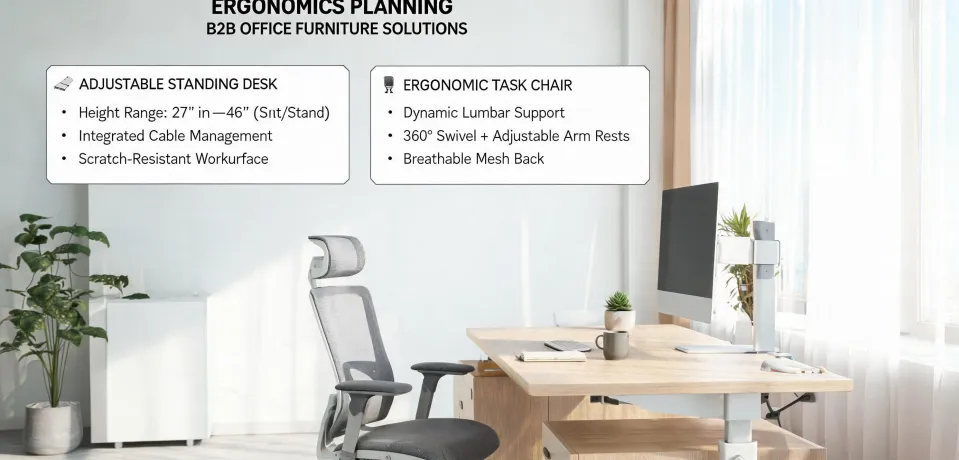
As for sit-stand desks, I'll be straight with you: a motorized desk isn't a health guarantee. It's a tool for moving during the day, and it only works if people actually transition a few times. The design details matter. A desk that takes 30 seconds of cranking won't get used. One that moves under electric power from roughly 25 inches to 50 inches in about ten seconds will. That's a big part of why electric sit-stand desks have become the standard for most offices — including companies buying online from brands like Uplift Desk, which operate as an online office furniture company and publish detailed height-range specs so you can match a desk to the actual person who'll use it, not to the team median.
For medical offices, the shopping list is different. In clinical settings, I prioritize cleanable surfaces (laminate or coated wood tops that tolerate disinfectant wipes), cable management that keeps wires off the floor, and a height range broad enough for the shortest and tallest staff members on every shift. If someone asks me what to look for in medical office furniture, that's my list: adjustable height, easy-clean construction, and a mechanism that a sleep-deprived resident can operate without reading a manual. Brands that sell online, like Uplift Desk, make this easier because their product pages publish the actual height ranges and materials up front — you don't have to call a sales rep to find out if a desk's minimum height works for your 5'2" receptionist.
Even after we recommended sit-stand desks to the clinic from that March 2024 call, I second-guessed the decision. What if the staff treated them as expensive, motorized tables? I didn't relax until the follow-up visit last June, when three of the six desks were in standing position by 10 am. They get used. The problem, as usual, wasn't the hardware.
Bottom Line
I've walked hundreds of teams through this sequence. The reaction, when it clicks, is always the same: "I had no idea." That phrase is the whole story. Most people aren't suffering because they don't have good chairs. They're suffering because nobody showed them how to use the chairs they're already sitting in.
Check the levers. Adjust per person, not per fleet. Write it down. And if the same static-posture pattern keeps showing up across your team, have the sit-stand conversation.
The cheapest fix costs ten minutes and a single printed page. Try that before you replace anything.

Discuss this article with a workspace planner