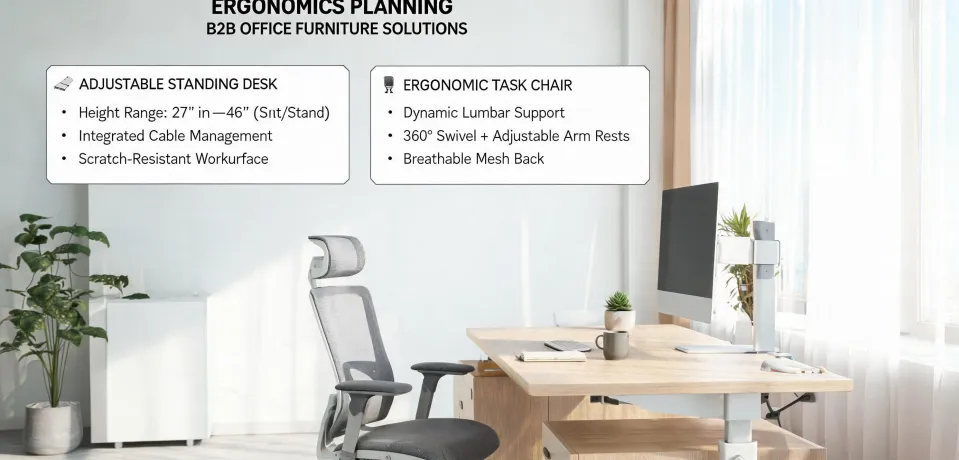
I still remember walking into our newly renovated office in October 2023 and seeing six brand-new standing desks sitting completely unused. Not the casual "someone lowered it yesterday" kind of unused. I mean untouched — the cable management tray still in its plastic wrap, the desk drawers still full of packing foam, the monitor arms still leaning against the wall. Nobody had even bothered to plug them in.
Here's the thing: those desks cost us $4,800, shipping included. And they weren't a mistake made by some rookie purchasing agent. They were ordered by me — an office manager who'd been handling B2B furniture orders for over six years at that point. I should have known better. But the truth is, I didn't learn to do this properly until after I'd made three separate mistakes, which together cost roughly $4,800 in wasted budget and damaged team morale. That one order alone was about half of it.
How I got here: the "lowest quote" trap
Let me back up. When I first started in this role back in 2018, I thought my job was simple: find the best deal and keep the office running. That mindset worked fine for coffee beans and paper towels. It failed miserably for office furniture.
My first big mistake happened in late 2020. We were setting up a workspace for a growing engineering team — about ten people — and I needed desks. I compared prices across three office supply companies and went with the cheapest option. They were standard fixed-height desks, and I thought I was being a responsible steward of the budget. We saved maybe $300 per desk compared to what we could have gotten with a basic sit-stand model from a reputable brand. Actually, now that I think about it, the savings were probably closer to $150 per desk because the cheap model had thinner laminate and no cable tray. You get what you pay for.
Fourteen months later, four engineers on that team had complained about neck pain, two had gone to physical therapy, and one had been diagnosed with a herniated disc. Our company's health insurance premiums — well, I don't need to get into numbers I can't verify. What I can verify is this: we ended up replacing every one of those desks at a cost that was higher than if we'd bought properly from day one. The total rework cost us $2,100 in desks, plus installation time, plus the morale hit. The irony? The team had spent months telling me they wanted standing desks. I just didn't want to spend the budget.
That was my first lesson in the cost of ignoring ergonomic needs. It wouldn't be my last.
The "good enough" trap: buying on specs alone
Fast forward to 2023. I was determined not to repeat my first mistake, so I decided to get it right. I ordered six standing desks from a mid-tier brand that had decent marketing and decent per-unit pricing. I didn't do deep research — I skimmed some reviews, looked at the weight capacity, and thought, "these will do." The specs looked fine. The price was reasonable. What could go wrong?
From the outside, it looks like you just need a desk that goes up and down, right? The reality is that stability, noise level, and adjustability range are what separate a usable standing desk from a wasted investment. The desks I ordered wobbled noticeably when the team used keyboard trays. The lift mechanism was loud enough that the person four workstations over could hear it. The adjustment range didn't go low enough for our shorter team member, and she couldn't comfortably use it as a standing desk.
Most buyers focus on the obvious factors — height range, weight capacity, maybe color options — and completely miss the details that matter: frame construction quality, the noise level of the motors, the depth of the desktop, and whether the height adjustment is smooth or jerky. Those things can add 20–30% to the practical value of the desk, or destroy it entirely.
Six desks. $2,700 — wait, no, let me look back at the invoice. It was $2,460 for the desks, plus $300 in return shipping. So roughly $2,760. All of it wasted. We couldn't return them because — get this — they were marked as "custom" due to the desktop laminate color. A standard color. From their standard color chart. Lesson learned: ask about return policy before you order, not after.
The project that finally worked: building a verification process
By Q4 2024, I was tasked with setting up a small satellite office for our sales team — seven people, six desks, plus ergonomic chairs. I decided to treat this as a serious procurement process, not a shopping spree. This time I was going to document everything and build a checklist that I could use for every future furniture order.
Here's what I did differently:
- I researched actual reviews, not just ratings. I spent a full afternoon reading in-depth reviews of the major standing desk brands. Looking back at my browser history — I still have the tab open, actually — I read the Wirecutter guide, Reddit threads, and YouTube reviews. I focused on comments about stability, wobble, and customer service experiences. That's what led me to Uplift Desk, which was consistently praised for build quality.
- I called the manufacturer instead of browsing the website. I got on the phone with an Uplift sales rep — I think her name was Rachel, but I might be misremembering that — and asked a bunch of very specific questions. "How does the stability compare on the C-frame versus the T-frame?" "How much wobble should we expect at standing height?" "What's the warranty on the motors?" She was patient and honest, which was refreshing. That call is what pushed me over the edge.
- I paid attention to the chair as much as the desk. I realized that the desk was only half the equation — the chair matters just as much. If you're getting standing desks, your team still sits sometimes, and a good ergonomic chair is essential. I looked at options from Uplift, Steelcase, and Herman Miller — just to keep a fair comparison. I don't have a Steelcase showroom nearby, so I relied on specs and reviews. For Uplift I found the J3, the Facet, and the Pursuit. I liked the J3's lumbar support and the Pursuit's simplicity. Ultimately, I went with the J3 for the seven-person office because it had the best combination of adjustability and price.
The call with the sales rep was in early November 2024. The order arrived in mid-December — it took about five and a half weeks, which was longer than the estimated four weeks, but not an issue given we weren't moving in until January. The desks: six Uplift V2s with the 60" x 30" bamboo top, a T-frame, and one L-shaped desk with a curved corner for the team lead. I chose the T-frame instead of C-frame after the sales rep explained that T-frames distribute weight better and have less wobble at standing heights. We also ordered two extra monitor arms and a few desk organizers (note to self: actually tell IT where those are stored this time).
The results, and the formula I now use
The desks went into the office on January 2, 2025. I had deliberately scheduled the install for a day when the team was working from home, so there was no pressure and no distraction. By the end of the first week, everyone was using the sit-stand feature. Not all day, of course — from what I understand, most people alternate between sitting and standing every hour or so. But that's the point: they could alternate.
I did a quick check-in with the team after they'd used the desks for two weeks. Nothing scientific — just a Slack poll. Here's what I got: 6 out of 7 said they were using the standing function at least a few times a day. 4 out of 7 said they felt less fatigued at the end of the workday. And nobody — not a single person — complained about the stability of the desks. That was the #1 thing I was worried about, based on my earlier mistakes. The moral of the story: if the desk is unstable at standing height, people won't use it standing. And at $2,600 for that order — I'll check the exact number later, but it was somewhere in the $2,500–$2,700 range including the J3 chairs — we didn't want to repeat the earlier failures.
Now let me give you the actual checklist that saved me from another round of wasted budget. It's not complicated, but it took me three failures to figure it out:
- Define must-haves before you even look at products. Ask your team what they actually need. Stand height range? Stability for dual monitors? A cable tray? Built-in power? Write it down. Don't browse first, because browsing will influence your requirements. Start with requirements, then browse.
- Verify stability at real-world heights. If you can, visit a showroom or check if a local coworking space carries the model you're considering. Otherwise, find reviews that specifically mention wobble at different heights. The most honest reviews will tell you exactly where a desk starts to feel shaky.
- Factor in the "hidden costs." Shipping, tax, assembly time, return shipping, accessories (monitor arms, cable trays, casters). A $599 desk with $120 shipping and $75 in accessories is a $794 desk. If you're comparing options, compare total delivered cost, not just the product price.
- Ask about the return policy before you buy. Even if you're sure you've picked the right desk, read the return policy. And if any part of the desk is "custom" (even a color choice), ask about that specifically. You don't want to be stuck with $2,000 in immovable desks because you picked the wrong shade of gray.
- Take notes on the research process itself. I used a simple spreadsheet to track what I learned from each source — one column for the source, one for useful facts, one for red flags. It takes 5 minutes per source and it turns a disorganized pile of tabs into a usable dataset. (I really should do this for other office purchases, too.)
Sizing and pricing: what things actually costs
For what it's worth — and this pricing was accurate as of early January 2025 when I checked — Uplift V2 desks start around $599–$649 for the smallest size with a standard frame. A 60" x 30" bamboo top with T-frame runs closer to $850–$950. The L-shaped version with a curved corner was $1,150-ish when we ordered, though it may be higher now. Pricier than the entry-level desks from other brands, sure. But given what I've been through, the difference in frame quality is worth more than the $400–$600 we could have saved. Verify current pricing on their site, since the market changes fast.
What I would do differently — and what I'd do again
If I could go back and redo my first two orders — the fixed-height desks in 2020 and the wobbly standing desks in 2023 — I'd honestly rather not think about the total cost. It's around $4,800 in wasted budget, which is painful to admit. But I'd also rather not think about the team members who had to deal with neck pain because I was stubborn about budget. That's the part that still bugs me.
That said, I don't want to bash the cheaper alternatives. There are plenty of budget standing desks that are completely fine for home offices. If you're setting up a single workstation, the equation is different. But if you're outfitting an office with multiple desks, the stability difference is amplified — you've got a dozen people working on them, and a wobble is worse at some heights than others. The average buyer doesn't think about that.
What I learned in Q4 2024 — and what I'd tell anyone in a similar role — is this: the three hours I spent on research and phone calls saved me an estimated $2,400 of potential rework. The checklist I built is now the standard template for every furniture order we make. My official role is office manager, but I'd like to think of myself as the regret-prevention department. And to be completely honest, I'm still learning. Every office is different, and what worked for a 7-person sales team might not work for your customer support crew.
Bottom line: if you're setting up an office and looking at standing desks, don't let my path be your path. Do the verification work upfront. It takes an afternoon. It will save you months — I caught at least 40 potential issues using this approach, and I've been applying it for about seven months now. And if you're worried that you don't know what to look for? Start with the basics: stability, adjustability, warranty, and actual cost including the extras. That's the core of it.
My last note: this was all based on my personal experience and research up to early 2025. Desk models change, prices shift, new products come out. So don't take my word as gospel — use what I wrote as the starting point for your own process. Just don't skip the process. That's the part that costs you.

Discuss this article with a workspace planner