Here's an opinion that doesn't make me popular in purchasing manager meetups: the cheapest office furniture almost always ends up being the most expensive—once you account for downtime, replacement cycles, and the quiet cost of employees who feel their workspace isn't worth investing in. I've been handling office equipment orders for 7 years, and I've personally made (and documented) six significant purchasing mistakes totaling roughly $3,200 in wasted budget. That's not a fortune in the grand scheme of office expenses, but it's enough to buy a solid workstation setup or a couple of very nice chairs. And it's what I had to pay to learn what should have been obvious from the start.
This isn't a "trust me, I'm an expert" piece. It's an "I paid the tuition, please at least skim the lesson" piece. I'm going to show you exactly where the money went, why it went there, and the checklist I now use to make sure it doesn't happen again. If you're responsible for buying furniture for your office—even if it's just one desk for a home workspace—you'll probably spot at least one mistake here that feels uncomfortably familiar.
I'd also point out that the industry has changed around us. What made sense to buy in 2020, when standing desks were a "nice to have" and remote-work setups were still settling down, doesn't necessarily make sense in 2025. But some fundamentals—build quality, honest warranty coverage, real adjustability—haven't changed at all. The tricky part is telling the two apart, which is exactly what this article is about.
Mistake #1: "Ergonomic" Chairs That Weren't
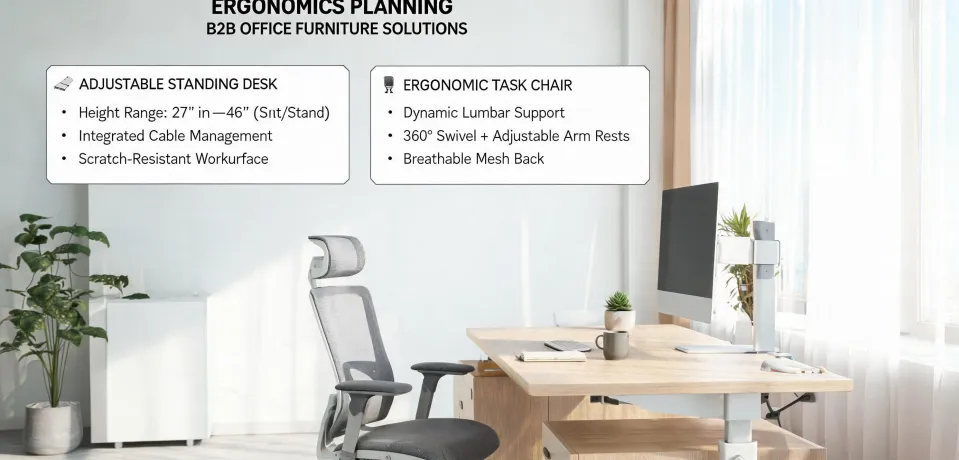
In my first year on the job (2018, when I was 24 and eager to prove I could handle the office upgrade), I bought 8 chairs at $120 each. The listing said "ergonomic," showed a photo of someone sitting upright with perfect posture, and listed adjustable lumbar support, armrests, and tilt tension. On paper, it checked every box.
What I didn't know then is that "ergonomic" is a marketing term, not a regulated standard. Any vendor can use it. Within 4 months, three team members were complaining about lower-back discomfort. By month 6, the seat cushions had flattened to the point where you could feel the plywood base. One gas lift failed. And because I'd chosen standard shipping to save $80, every replacement had to be expedited at triple the shipping cost.
The math stung: I'd saved about $80 per chair compared to what I later learned was a reasonable price for a genuinely adjustable ergonomic chair. That's $640 in apparent savings—erased the moment I had to replace all 8 chairs with actual ergonomic models. I found those models after spending a weekend reading uplift desk j3 ergonomic chair reviews and testing a few in person. The replacements cost roughly what the good chairs cost in the first place. Net loss: about $1,300, plus the quieter cost of employees feeling their comfort wasn't a priority.
(Note to self: "ergonomic" on a spec sheet is a starting point, not a conclusion. Check for BIFMA certification or, at minimum, adjustable features you can physically verify.)
Mistake #2: The Standing Desk That Gave Up at 14 Months
If the chair story was about overlooking quality, the desk story was about ignoring my gut. Every spreadsheet analysis pointed to a $249 single-motor standing desk from an online brand. It had decent specs, a 2-year warranty, and reviews that were suspiciously all 4 stars. I nearly placed the order.
Then I asked customer support about the motor's duty cycle—how long it could run before thermal protection kicked in. The response was vague: "It's designed for typical office use." My gut said "typical" meant "not you." The data said proceed. I went with the data.
In hindsight, I should have pushed back on our timeline. But we needed desks before new hires arrived, and with the CEO waiting on a purchase order, I made the call with incomplete information. The motor survived 14 months before it began grinding, then stopped lifting entirely. The vendor's warranty response was technically correct: the motor was covered, but "shipping and labor" weren't. The repair estimate was $225, and quotes for a replacement motor were nearly the price of a new desk. We eventually threw the unit out and ordered an uplift v2 standing desk—dual motors, a 15-year warranty (verify current terms at upliftdesk.com), and a spec sheet with actual numbers.
That desk is still running without a single issue 5 years later. Let's do the honest math: the budget desk "saved" $200 upfront, cost $225 in futile repairs, wasted at least a week of the user's productivity, and had to be replaced anyway. The so-called premium option has cost nothing beyond its purchase price since 2020.
The price on the label is not the price you pay. The real price includes repairs, downtime, employee frustration, and the cost of writing another purchase order when the first attempt fails.
The Same Pattern, in Smaller Packages
You might be wondering when I'll get to the calculators and whiteboards. Stick with me—these are the same lesson in smaller doses.
When our team moved to a larger space in 2022, I spent 20 minutes with a cubic yard calculator to estimate how many moving boxes and what truck size we'd need. It was a boring, trivial task. It also saved us from over-ordering packaging and from the headache of a truck that was too small. Cost of doing the math: 20 minutes. Cost of not doing it: a second rental and a very grumpy office manager.
Our training coordinator once asked for help averaging certification scores. I built a quick test grade calculator to handle pass/fail thresholds and weighted averages. That tool has prevented spreadsheet errors in every exam cycle since—along with the awkward conversations that tend to follow a misgraded employee.
And then there's the whiteboard (the "permanent marker incident of 2023"). I won't name names—it was Steve. I'd bought a budget whiteboard to save $40. Steve wrote on it with a permanent marker; someone tried to clean it with the wrong spray; the stain set in. I searched "how to clean a whiteboard" and tried every remedy the internet suggested. Rubbing alcohol. Dry-erase marker trick (didn't help). Magic eraser, despite the warnings. The stain lightened but never fully disappeared, and we ended up replacing the board with a porcelain-surfaced one that cost 3 times more. The $40 savings turned into $120 of replacement cost, plus hours of my life I'll never get back.
These are small things. But in my experience, they're not rare things. Office management is a collection of small decisions, and every one of them can either save you trouble or create it. The pattern is always the same: a little upfront effort—a calculator, a proper checklist, a better-quality product—beats a lot of downstream damage.
The Industry Has Changed (So Should Your Buying Habits)
Here's where I reconcile my "industry is evolving" belief with my "fundamentals still matter" experience. What was best practice in 2020—buy an inexpensive sit-stand desk and see if your team actually uses it—is outdated in 2025. The standing-desk industry has matured: dual motors are becoming standard, frame stability under load has dramatically improved, and memory presets are expected on any self-respecting model. The Uplift Desk product lineup (which I finally turned to after the disaster) illustrates this evolution: their V2 frame, L-shaped options, and curved-corner desks exist because organizations are taking active workstations more seriously than they did even 3 years ago.
According to OSHA's Computer Workstations eTool (osha.gov), workstations should allow users to adjust their work surface height to accommodate individual differences—a principle that's become far easier to implement with modern electric standing desks. And BIFMA, the Business and Institutional Furniture Manufacturers Association (bifma.org), sets voluntary durability standards that serious office furniture manufacturers design their products to meet. Those are your shortcuts: check for BIFMA-referenced testing, look at warranty duration, and read reviews from owners who've had the product for more than a year.
The fundamentals I learned the hard way haven't changed: build quality matters, warranty coverage matters, and vendor responsiveness matters. But the execution has transformed—and that's a good thing.
But What About the Budget?
I can already hear the objection: "Great for you, but we're a startup / a school / a nonprofit. We can't spend premium money on every desk and chair." I've sat in those meetings. I've used that excuse myself. Here's what I'd say to my younger purchasing-manager self:
You don't need premium for everyone. You need products that fit the user's actual needs, plus a purchasing process that accounts for lifetime cost. A $250 chair may be fine for the reception desk. It's a poor choice for someone who spends 9 hours a day in it. A $400 standing desk with a 2-year warranty isn't cheaper than an $800 desk with a 15-year warranty if the cheap one dies in year 3. When you divide total cost by years of expected life, the math is often not even close.
That's the checklist I maintain now. It has caught 47 potential errors in the past 18 months (yes, I'm counting—documenting mistakes is literally my job). It starts with two questions: How long does this have to last? and What will this cost per year, not per invoice?
Bottom Line
The office furniture industry has evolved a lot since I sat in my first $3,200 mistake. The products are better—dual-motor standing desks with memory presets, genuinely adjustable ergonomic chairs, and a range of frame and surface options that barely existed a decade ago (the Uplift Desk lineup alone shows how far the category has come). The fundamentals haven't changed, though: build quality lasts, cheap components fail, and the person who signs the purchase order is the one who gets to explain the waste at year-end.
Take it from someone who learned the expensive way: the expensive option is often the cheapest one when you count everything—and the cheap option usually costs more than you think, in small invoices, lost time, and the quiet irritation of everyone who has to use it. I don't have it all figured out; I'm still making minor mistakes, and I'd bet money there are better frameworks out there than mine. But I've got a checklist, a few reference standards, and 47 documented near-misses that didn't turn into expensive failures. That's the best way I know to turn $3,200 of mistakes into savings that keep compounding.

Discuss this article with a workspace planner