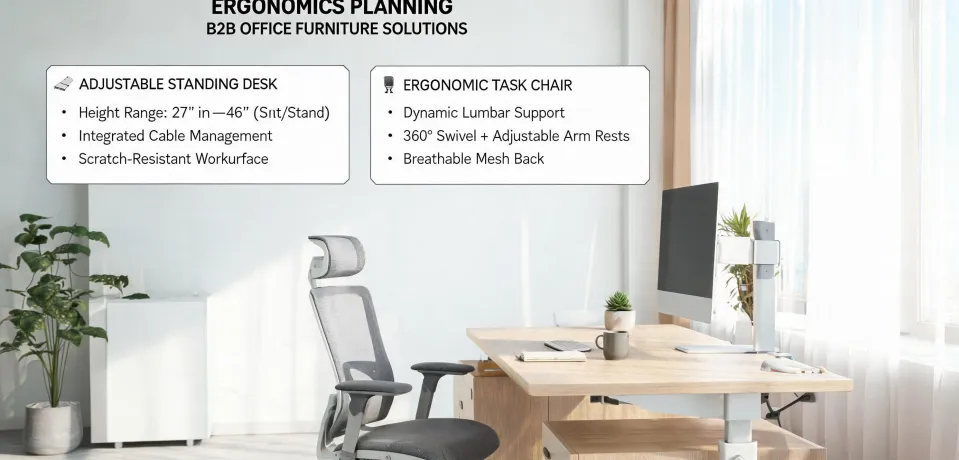
This checklist is for buyers who need to outfit a team with standing desks and ergonomic chairs without letting the project turn into a cost overrun. I'm a procurement manager at a 38-person architecture firm. I've managed our facilities budget for five years, tracked every order in a cost system, and negotiated with more furniture vendors than I can count. If you're comparing an Uplift Desk order, or just trying to standardize your office equipment, this is the process I use.
There are six steps below—each one ends with a specific check. Don't skip ahead. The order matters.
The 6-Step Checklist
1. Map the workstations, not the wishlist
Before you look at frame colors or fancy cable trays, list who actually sits where. I once said 'we need sit-stand workstations for the design department.' My manager heard 'every workstation in the company, including the part-time interns.' Result: the first quote was 60% higher than what we actually needed.
The check here: write down each job role, how many hours that person is at a desk, and the physical dimensions of the space. Don't order until every workstation has an owner and a floor plan.
One detail people forget is depth. A 30-inch-deep desk might fit a laptop but not a dual-monitor clamp setup. The Uplift V2 standing desk 36 inch depth option gives more room for large monitors, but it also needs more floor space. Measure the room and the chair clearance before you spec it.
2. Calculate TCO, not unit price
A $699 desk and a $1,099 desk don't look that different on a quote. They look very different after you add freight, white-glove assembly, cable management, and a warranty. I built a simple limit calculator in our procurement spreadsheet: (desk + shipping + assembly + accessories + expected maintenance) / expected lifespan. That's the number that matters.
When we compared quotes in 2024, the 'budget-friendly' option was 23% higher over a five-year horizon once we included replacement parts. I didn't see that until I put the full cost into a limit calculator. The cheaper frame wobbled after two years, and the company spent more on repairs than we saved on the original price.
The check: get a five-year cost per workstation, not a per-unit price. If a vendor won't share maintenance or parts costs, that itself is a sign.
3. Verify the ergonomic claims
Don't buy something because the marketing page says 'ergonomic.' Per FTC guidelines, advertising claims have to be truthful and substantiated. But 'substantiated' in marketing language isn't the same as 'tested by the people who'll use it.'
The Facet ergonomic chair by Uplift Desk is one of the models I've tried. It has a lot of adjustment points, and the seat depth works well for taller team members. But I still order a demo unit before I commit to twenty. If a vendor won't offer a trial, that's a red flag.
Also ask about materials and environmental claims. Per FTC Green Guides, a product labeled 'recyclable' should be recyclable in areas where at least 60% of consumers have access to appropriate facilities. If the marketing page says 'sustainable' without specifics, follow up before you sign.
The check: every 'ergonomic' or 'eco-friendly' claim should have a document, a test report, or a spec sheet behind it. If not, keep it on the follow-up list.
4. Lock down lead time with a penalty clause
The vendor failure in March 2023 changed how I think about backup planning. We'd scheduled an install crew, and a 'guaranteed two-week' desk shipment arrived six weeks later. The crew moved on to another job, and the office sat half-finished. One critical deadline missed, and suddenly redundancy didn't seem like overkill.
Now I ask three questions before any PO: Is this a guaranteed ship date? What happens if it slips? What's the fastest option for replacement parts? The old 'buy local so you get service' thinking comes from an era when online furniture brands didn't have dedicated freight partners. That's changed. A good direct brand with white-glove delivery can be more reliable than a reseller who has to back-order from the same factory.
Yes, expedited shipping costs more. In March 2024, we paid $400 extra for rush delivery on a custom top. The alternative was missing a $15,000 event that depended on the office being ready. That $400 bought certainty, not just speed. When a date is firm, an uncertain cheap option is more expensive than a certain one.
For small replacement parts, don't assume overnight. According to USPS, effective January 2025, a First-Class Mail letter is $0.73 and a large envelope starts at $1.50. If you're waiting on a cable or a bracket for a remote employee, match the shipping class to the deadline. The point isn't to become a shipping expert—it's to stop hoping.
The check: get the delivery commitment in writing, and make sure the contract says what happens if the date is missed. Add a delivery window to your order notes.
5. Set approval limits and tax rules before you sign
This is the step most people skip. Tie every order to a spending limit calculator so you don't approve by gut feel. Our policy: a single workstation over $1,200 requires a second signature, and anything over $2,500 gets a total-cost review. That's not bureaucracy. It catches scope creep before the PO goes out.
And get the tax treatment sorted early. If you're buying furniture for a company-owned office, it's a capital asset. If you're doing a home-office stipend, it's a different animal. I'm not a CPA, and I won't pretend a married filing jointly vs separately calculator belongs in a furniture spec. But your finance team should decide the classification before you order, not when the invoice lands.
The check: define your approval threshold, and write down whether this is a company asset or an employee stipend. Both decisions should be made before the quote expires.
6. Add a scope-creep gate
The last step is the one that protects all the work you've done. Once the PO is approved, someone will ask for extras. 'Can we add a footrest? What about a yeti lunch box for the breakroom? Should we upgrade the monitor arms?'
The answer isn't no. It's 'not in this PO.' If it's not in the original workstation spec, it goes into a separate request. Without a gate, an $18,000 desk order can become a $24,000 order because nobody enforced the boundary. I learned this the hard way when a 'small' accessories request added $1,100 in shipping because we split it into three deliveries.
The check: any item not on the approved workstation list automatically requires a new request. No exceptions for small-dollar items.
Common Mistakes to Avoid
- Choosing a desk width without checking depth and floor space. The Uplift V2 standing desk 36 inch depth is a great match for big monitors, but only if the room supports it.
- Comparing quotes by unit price instead of TCO. Use a limit calculator for the full five-year cost.
- Trusting 'probably by Friday.' If you need certainty, pay for it and get the guarantee in writing.
- Believing 'ergonomic' without documentation. FTC rules require truthful claims, but you still need to verify the specifics.
- Mixing personal tax questions with a company purchase. A married filing jointly vs separately calculator is a personal finance tool, not an office furniture decision.
- Letting add-ons like a yeti lunch box turn a workstation order into a general shopping spree. Keep the scope tight.
The goal isn't to find the cheapest desk. The goal is to avoid surprises. Run a TCO, verify the specs, lock the lead time, and keep the scope gate closed.

Discuss this article with a workspace planner