I manage purchasing for a 40-person B2B agency. Our office budget sits around $180,000 a year, and I've been tracking every invoice for the last six years. So when someone looks at an Uplift desk and says, “You're paying too much,” I get it. I used to think the same thing.
When I first started buying standing desks, I assumed the lowest quote was the right quote. That assumption cost us more than I want to admit. It also taught me the only purchasing framework that matters: total cost of ownership, or TCO.
The surface problem: a standing desk seems like a commodity
On paper, a standing desk is simple. You buy a metal frame, a top, maybe a cable tray. If you're just comparing prices, an Uplift standing desk looks expensive next to a random “adjustable desk” listing. I know that because I built a comparison spreadsheet in 2022 with eight vendors. One quoted $350 less for the same basic dimensions.
I almost went with that cheaper desk. The only reason I didn't was that our operations manager asked about the warranty. That question led me down a rabbit hole that changed how I do every office purchase.
The deeper reason: we quote price, but we pay TCO
TCO sounds like finance jargon, but it's just what happens after the invoice. The sticker price is not the cost. If you've ever bought a desk that needed missing hardware, a technical call, a replacement controller, or a whole new file cabinet because the first one didn't fit, then you've already lived TCO. You just didn't have a name for it.
I didn't either. Early on, I tracked “office furniture” as one budget line. When a $390 desk frame finally cost us $480 after shipping, plus $150 of my assistant's time to build it, plus $220 for a replacement controller that the “2-year warranty” didn't fully cover, the real number was nowhere near $390. It was $850. A $650 all-inclusive option would have been cheaper.
That's the mental shift I had to make: compare the installed, supported, working price, not the listing price.
What actually adds to the total cost
Here's where I see the biggest hidden costs in an office desk decision. Not all of these apply to every Uplift desk order, but they apply to the process of comparing desks.
Shipping, delivery, and “free” shipping
Free shipping isn't free. It might mean curb-side delivery, which for a 70-pound desk frame means someone in your team has to get it from the street to the office. If your office is on the second floor, that's not free.
I've also had vendors ship replacement parts in oversized boxes and then charge return shipping for the parts they sent by mistake. According to USPS pricing effective January 2025, the cheapest First-Class Mail letter is $0.73 (usps.com/stamps). That's a trivial cost. The non-trivial cost is the hour your office manager spends opening boxes, taking photos, and waiting for the right part.
Assembly and setup time
Assembly time is a real cost. A desk that takes thirty minutes to assemble is not the same as a desk that takes two hours. If you're paying someone an hourly wage to build six desks, the difference is measurable. I don't use my own hourly rate in these calculations. I use the actual cost of whoever touches it.
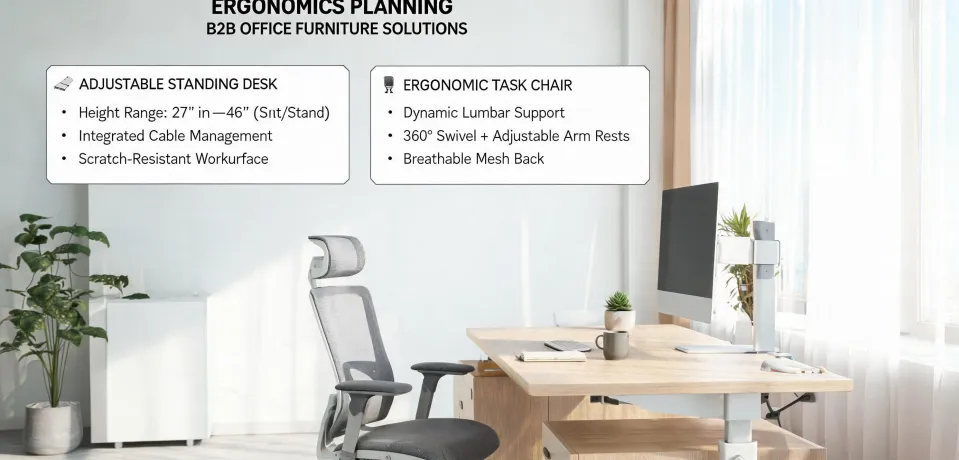
One of the things that impressed me about the Uplift desk specs was that they list the frame dimensions, the wire routing options, and a manual that tells you exactly how many screws are where. That sounds basic, but you would be surprised at how many vendors don't do it. I'd rather spend a few extra minutes reviewing a spec sheet now than spend a week sorting out what a vendor didn't publish.
Accessories that don't fit
This is where the Uplift desk file cabinet gets unfairly criticized. I used to think a file cabinet is a file cabinet. Then we bought one for a sit-stand desk, and the drawer hit the desk underside when the desk was in sitting position. The cabinet was too tall. We had to replace it.
The Uplift desk file cabinet is priced higher than a basic file cabinet. But it's designed to fit under a standing desk at its minimum height. That compatibility is not a luxury; it's a cost-avoidance feature. If a cheaper cabinet doesn't fit and you have to buy a second one, the “cheap” cabinet was never cheap.
Same logic applies to cable trays, monitor arms, and keyboard stands. I now check whether the accessory is built for the same desk or just “universal.” Universal usually means “fits some desks, and not yours.”
Warranty fine print
Warranty language is where the real differences show up. Some vendors cover the frame, the top, the electronics, and the labor. Others cover only the frame and make you pay shipping both ways.
I'm not a lawyer, so I read warranty terms more carefully than I read marketing pages. Per FTC guidelines, claims about products need to be truthful and substantiated (ftc.gov/business-guidance/advertising-marketing). When a vendor makes a promise that sounds too broad, that's a red flag. I look for vendors who are specific about what's covered, for how long, and who pays for what.
The cost of the stuff around the desk
The cheapest standing desk in the world doesn't help you if your printer is still on the floor and you can't connect it to the office network. During our last office refresh, I added three desks and forgot to schedule time for the non-desk tasks. The office manager ended up searching “how to set up hp printer to wifi” at 4pm on a Wednesday. She eventually got it working, but it took 90 minutes and a very patient IT-support person on the phone.
That's a hidden office cost. The desk itself wasn't the problem. The problem was treating the desk as the whole project. If you're doing a standing desk rollout, plan for the peripherals. Printers, monitor arms, cable management — they all have setup time. Add that time to the TCO.
The same math applies to calculators
I'll go one step further. The TCO mindset shouldn't stop at furniture. When I compare advertising options, I use a CPM calculator to understand actual cost per thousand impressions instead of just looking at the total spend. When my daughter was prepping for college tests, she used an SAT score calculator to see how many practice questions she needed to get right to move her score. Both are the same idea: know the underlying unit cost, not just the upfront number.
If you're a marketer, a CPM calculator tells you whether the “cheap” ad platform is actually delivering impressions that matter. If you're a parent, an SAT score calculator helps you decide whether a prep course is worth it. And if you're buying office furniture, TCO tells you whether a premium desk is worth it.
The real catch: the cheaper desk can cost you double
Let me give you a concrete example from our office, with the numbers from my tracking spreadsheet.
In Q2 2024, I compared two standing desk options for a four-person team. One vendor quoted $4,600 for four desks with all accessories, including delivery and assembly. Another vendor quoted $3,950 for four desks, but without cable management trays, without a compatible file cabinet, and with “white glove” delivery listed as an extra.
I almost went with the $3,950 option. Then I added the extras: $600 for delivery to our floor, $180 for cable trays, $450 for a compatible file cabinet, and $200 for assembly time. The total came to $5,380. The “more expensive” vendor would have been $780 cheaper in the end.
That's not a hypothetical. It's the difference between looking at a quote and looking at a total cost. I've made this mistake. I'd rather not watch you make it.
What I do now (and it's not complicated)
I don't start with the brand. I start with the specifications. For an Uplift standing desk, I check the height range, the width options, the laminate options, the frame warranty, and whether the accessories I need are in stock. If the answer to any of those questions is vague, I treat that as a cost risk.
Even after we placed our first order for four Uplift desks, I kept second-guessing. What if the premium was just marketing? The three-week lead time didn't help. It wasn't until the desks arrived, the assembly went smoothly, and the final invoice matched the quote that I relaxed.
Then I ask four questions before any desk purchase:
- What is the installed price, not the sticker price?
- What happens if a part is missing or damaged?
- Does the warranty cover the electronics, not just the frame?
- Do the accessories I need actually fit this desk?
That's the whole framework. I don't need a twelve-page procurement process. I need those four answers on paper.
The bottom line
Is an Uplift desk worth it? I don't know your budget, your team, or your building. I'm not going to tell you that one desk is perfect for everyone. But I can tell you this: the desk that wins the purchase-order comparison is often the one that loses the total-cost comparison.
When I started this job, I thought the goal was to find the cheapest possible option. Six years and a lot of invoices later, I think the goal is to find the option with the least surprise. Uplift isn't the brand I order for every project. But it's the brand I've ordered when I wanted the specs to match the invoice, and I've never regretted that decision. There's something satisfying about an invoice that matches the quote. After six years of watching small discrepancies add up, I'll pay for that kind of predictability.
If you're comparing desks, compare the whole cost. Use a cpm calculator for your ad spend, use an SAT score calculator for your test prep, and use TCO for your office furniture. Sticker prices are just the start of the conversation.

Discuss this article with a workspace planner