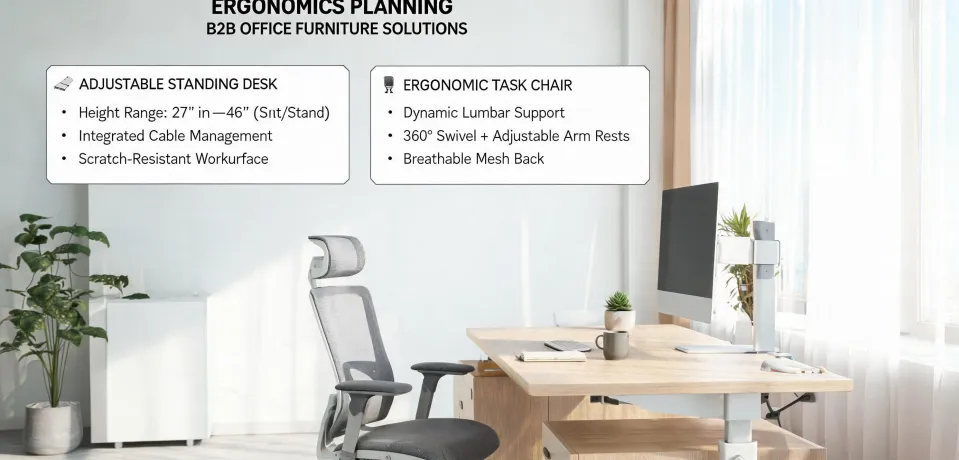
I think most office managers make a costly mistake when they buy standing desks: they focus on the upfront price tag and ignore the long-term cost of a bad purchase. I'm not talking about the desk's price. I'm talking about the productivity lost, the health claims that backfire, and the hassle of replacing cheap equipment within two years. And I say this as someone who manages an annual operating budget of around $80k and has to answer to both the operations director and the finance team. Let me explain why a premium desk, specifically the UpLift V3, is the more financially responsible choice, even when your CFO is asking why you can't just get the budget option.
My Argument: Cheap Desks Cost More In The Long Run
Here's the thing: I've processed over 400 orders in the last four years across seven different vendors. I've seen the full spectrum, from $300 standing desks that wobble when you type to the high-end electric models. And my conclusion is simple: buying a cheap standing desk is one of the most expensive decisions an office can make. Period.
Argument 1: The Real Cost of a Wobbly Desk is Lost Productivity
When I took over purchasing in 2020, our company was expanding rapidly. We bought 20 budget standing desks for a new department. The price was great—about $350 each. Everyone was thrilled. Three months later, the complaints started. The desks wobbled at standing height. People stopped standing because the instability made them uncomfortable. They stopped switching positions. The entire ergonomic benefit was gone—all to save $150 per desk.
From a procurement perspective, that investment was a failure. We spent money on a feature (sit-stand capability) that our team didn't use. That's not a 'desk purchase.' That's wasted capital. In contrast, when I later ordered eight UpLift V3 desks for a pilot program, users actually used the standing feature after 6 months. They reported fewer mid-afternoon slumps. That translates to real productivity, which is hard to measure but impossible to ignore.
Argument 2: Health Claims Are A Liability, Not A Marketing Gimmick
I'm not a physical therapist or an ergonomics specialist, so I can't tell you which desk will fix your back pain. What I can tell you, from a buyer's perspective, is that making health claims you can't back up is a bad idea. If a vendor implies their cheap desk will 'eliminate back pain,' and it doesn't, you're on the hook with your employee. We had a near-miss with a budget vendor whose marketing materials made strong health promises. Our legal team flagged it immediately.
I don't make health guarantees about furniture. But I do know that an unstable desk that encourages someone to stay seated all day is health-negative. A premium desk with a solid frame and a quality motor—like the UpLift V3's dual-motor system—is a tool that enables good habits. It doesn't promise miracles, but it doesn't create new problems either. That's the difference between a smart investment and a risky gamble.
Argument 3: The Hidden Costs of Replacement
Look, every office manager learns the hard way that buying cheap often means buying twice. That budget desk from our 2020 expansion? We replaced half of the motors within 18 months. Each replacement involved: the time to diagnose the issue, the hassle of dealing with a slow support team, the cost of shipping the desk back (which wasn't covered), and the labor to reassemble it. The total 'hidden cost' for those 20 desks was roughly $3,000 in lost time and direct expenses.
In contrast, after five years of managing these relationships, I've learned that a supplier who can handle a complex order—like a mixed shipment of L-shaped desks and regular electric models—without messing up the delivery is worth paying a premium for. UpLift's fulfillment, in my experience, has been reliable. They ship correctly, the packaging is sturdy, and the assembly instructions are clear. That saves my team hours of frustration. 5 minutes of verification beats 5 days of correction. The verification is paying the premium upfront.
Addressing the Obvious Question: 'But My Budget is Tight'
I get it. Every buyer faces this tension. You have a budget from finance, and the cheapest option looks like a win. But I've found that the real financial win is in the total cost of ownership. A $600 UpLift V2 or V3 desk that lasts 10 years is cheaper than a $350 desk that lasts 2 years. Do the math. The premium desk costs $60 per year over a decade. The cheap desk costs $175 per year, and that's before the hidden costs of wobbly frames and broken motors kick in.
The company I work for consolidated our office furniture purchasing in 2023 for 100 employees across two locations. We standardized on a mid-range standing desk with a solid warranty. The upfront cost was higher, but the number of support tickets about desks went to zero. That alone saved our IT team and facilities manager dozens of hours, which more than covered the price difference.
I'm not saying every company needs a top-tier, fully customized, curved corner desk. But I am saying that treating a standing desk like a disposable commodity is a mistake. It's a tool your team uses for 8+ hours a day. If the tool fails, so does their comfort, and so does their output. That's not an expense. That's a productivity risk. And I'd rather invest in preventing that risk than explaining to my VP why we need to spend more money to replace the mistake I made two years ago.

Discuss this article with a workspace planner