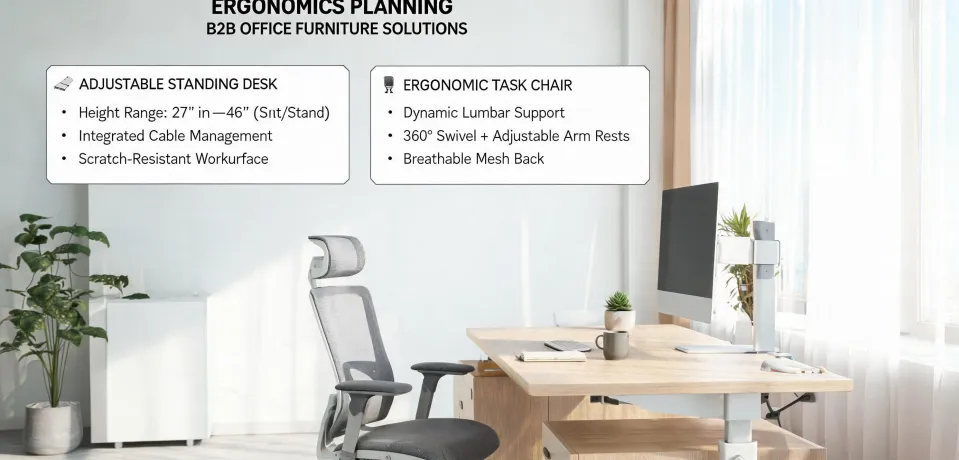
I didn't start this Uplift V2 standing desk review as an Uplift fan. I manage office purchasing for a 64-person product development company, and my default answer to a premium desk quote is usually: show me the cheaper option. But this spring, when I compared Uplift Desk's V2 with the lowest-priced electric standing desk from a national office supplier, the cheaper option lost its appeal after I itemized everything it didn't include. This review is that comparison: Uplift V2 vs. budget electric desk, line by line.
Why I compared the V2 to a budget standing desk
I could have compared the Uplift V2 to another premium standing desk brand. That makes for fun content, but it doesn't reflect a typical buying decision. The more common decision is: should we buy the desk that has a recognizable name and a real warranty, or the one that will still leave room in the annual budget for an extra monitor? I wanted an answer I could defend to our finance team.
I won't name the budget model because this problem is not limited to one brand. It's a pricing strategy: quote a low number, let the buyer discover the rest later. The two numbers I started with were $756 per desk for the budget frame and $1,284 for the Uplift V2 in a 60x30 laminate configuration. After that, the comparison gets more interesting.
What a quote can hide
This is where I've been burned before. When I audited our 2023 office spending, I found that several orders had gone through with extra freight charges that were never mentioned during sales calls. The so-called delivered price wasn't a delivered price at all. So for this project, I asked every vendor for a quote that included commercial delivery to our floor.
The Uplift quote included shipping and liftgate delivery to our building. The budget quote did not. After adding liftgate and inside delivery to a commercial address, the budget desk went from $756 to $921. Then I added the labor our office manager and facilities person estimated for unpacking and assembly: about 45 minutes per desk. At a fully-loaded internal cost of $58 per hour, that added $44 per desk. The budget unit's total came to $965. The Uplift V2 was still about $319 more, but the gap had shrunk by 40%.
The vendor who lists all fees up front, even when the total looks higher, usually costs less in the end.
I can already hear the objection: any office can assemble a desk. That's true, but time is real money. And the support problem does not end when the box is open.
Uplift V2 specs worth comparing
When someone asks me for Uplift V2 standing desk specs, I start with the numbers that matter to a purchaser: published weight capacity, height range, motor setup, and controller memory. According to Uplift's product specification page on upliftdesk.com as of July 2025, the V2 frame is rated at 355 lb. It has two motors. The standard height range with a one-inch desktop sits roughly between 25 and 51 inches. It uses a keypad with four programmable height presets.
Those preset heights matter more than marketing suggests. If an employee can save their sitting and standing positions, they're more likely to actually change positions during the day. The budget unit I evaluated had a single motor, was rated at 265 lb, and had a handset with no memory. It also topped out at a lower maximum height. That's a practical issue for a team with tall people, not a spec sheet obsession.
Stability was the biggest physical difference. I understand that a one-desk test is not a laboratory study, so I'll describe it carefully. With the same two-monitor load on each desk at standing height, the Uplift V2 had a small sway that stopped quickly. The budget desk had more side-to-side movement, and it did not settle as fast when I typed at the keyboard. For an employee who does focused work, that difference translates into constant micro-adjustments. It's exhausting by the end of the day.
Warranty changes the annual cost
This is the dimension where the comparison flips.
The budget vendor quoted a one-year warranty and said repairs require shipping the whole unit back to a regional depot. Shipping that desk would require a freight crate and at least two people to handle it. In practice, a failed motor would probably mean buying a new desk rather than repairing the old one. The Uplift V2 page lists a 15-year warranty on the frame, with replacement parts shipped to the account address. I have that document saved in the same folder as our PO.
Now the annual math changes.
If a budget desk costs $965 and needs to be replaced every four years in a continuous-use office, it costs about $241 per year, plus the labor of every replacement cycle. If the Uplift V2 costs $1,284 and is designed to work for ten years or more, which is what a 15-year structural warranty implies, it costs about $128 to $160 per year. The low cost option becomes the high cost option as soon as you annualize it.
I know the investment-minded reader will run the original $528 difference through a savings bond calculator and say it could grow into a nice office-equipment fund. Maybe. But a desk is not a savings bond. It is equipment that employees use for the majority of their waking day, and deferred costs usually show up as support tickets, wobble, and early replacement.
Support and downtime: the uncounted line item
One more thing pushes the V2 ahead: the experience after an issue. During the 2024 office overhaul, one of our old electric desks failed at the controller. It took four emails, a 32-minute hold, and seven business days to get a replacement. Nobody remembers the original cost saving; they remember the week the desk was stuck at standing height. The replacement path for the Uplift V2 is simpler, because the replacement part ships directly and you install it without sending the whole desk back. That type of service is hard to price, but it has a real value.
I'm not claiming any desk will never fail. I'm claiming that warranty terms should be evaluated the same way you evaluate the vendor's business: if the desk breaks in year three, will this supplier still exist, and will they be easy to deal with?
So what should you buy?
If you are choosing between these two categories for a full-time workstation, buy the Uplift V2. I ordered eight of them after this comparison, and I don't expect to reorder them before the next office lease renewal. The V2 is also the one I quote in budget conversations when someone asks what a truly adjustable desk costs.
The budget option still has a place. For a touchdown station, a conference room overflow seat, or a temp workstation that will be reconfigured in a year, the lower-cost frame is reasonable. It carries less warranty, but it also carries less risk if it's used only occasionally. Just don't put it where people will rely on it for eight hours a day.
And if you're comparing an Uplift V2 with an Uplift V3 curved corner or an L-shaped model, the logic is the same: start with included shipping, compare warranties, and calculate the cost per year that the desk will actually support someone. It's the math behind the desks that turns out to be the most important feature.

Discuss this article with a workspace planner